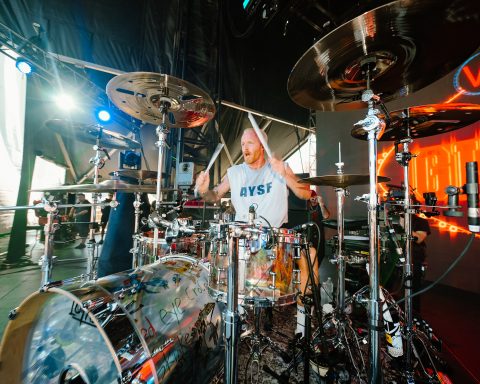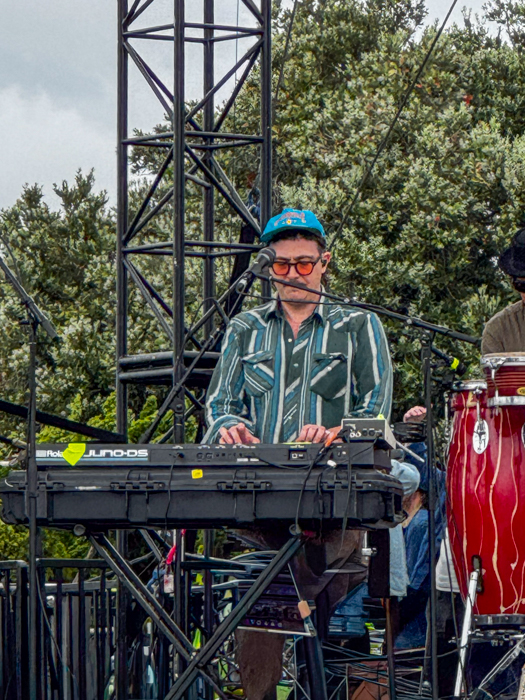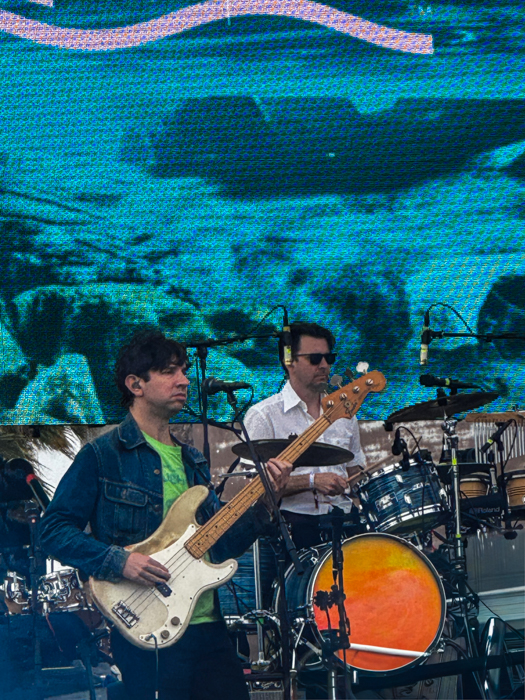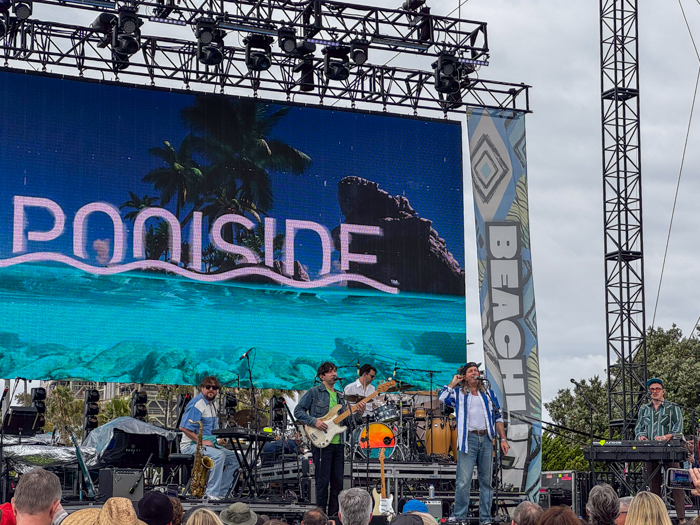


Over the past decade, Poolside has carved out a sound that is both instantly recognizable and quietly subversive—easygoing on the surface, but built on a deep attention to texture, tone, and detail. At the center of this is Jeffrey Paradise, whose long-standing relationship with Roland gear has shaped the project’s blend of analog warmth, modern flexibility, and understated groove. Alongside bandmates Vito Roccoforte and Casey Butler, Paradise discusses how this identity has evolved from the studio to the stage, where the focus shifts to building a live setup that balances precision, spontaneity, and feel.
From Punk to Poolside
Sitting at a picnic table in the artist compound on the final day of BeachLife Festival in Redondo Beach, CA, Jeffrey Paradise is right where he envisioned his music being played. The Pacific Ocean laps the shoreline just steps away as he dives into Poolside’s origin story.
It wasn’t about chasing a trend. It was about rejecting one. “It sounds ridiculous, but Poolside started almost as a rebellious sound, like rebelling against the kind of more introspective, angry indie music,” he laughs. “I wanted to make music that’s fun and chill.”
At the time, that mindset put them outside the prevailing scene. “Now there’s lifestyle music and playlists, so it doesn’t sound so bizarre. But in 2011, it wasn’t. It felt pretty weird. This was rebelling against what an indie kid should do.” The contrast between past trends and current acceptance highlights Poolside’s unique position from the outset.
Inventing “Daytime Disco”
The “daytime disco” aesthetic came from a mix of DJ instincts, cultural references, and good timing. Paradise was drawn to a type of electronic music that didn’t quite have a place…yet. “There are a lot of cool records, Daft Punk or Basement Jaxx, where they have the slower electronic song that a DJ could never play. What if that was the inspiration for the sound?” he asked. “It’s just the slower electronic stuff you can’t DJ.”
That idea intersected with childhood influence. “I’m from San Diego, and there’s a big low rider culture there. They play oldies, like slow soul music—it’s chilling at the park kind of music. That always seemed really cool,” he says.
And then there was the desire to create the kind of music Paradise wanted to hear. “You go over to a friend’s barbecue at like 3 p.m. on a Sunday in Los Angeles, and it’s just like…dubstep blaring. And I was just like, ‘This is fucked up.’ So, I wanted to just make music for people like me, what we should be listening to at these backyard hangs.”
What started as an almost throwaway concept became a defining sound. “I didn’t think it would go much further than backyard parties for my friends. We’re fifteen years in now. It’s crazy.”
Dialing In the Sound
Paradise doesn’t hesitate when asked about Roland’s role in Poolside’s sound—it’s everywhere, both in the studio and onstage. “It’s funny—I realized onstage that almost everything we use is either Fender or Roland. I just really like Roland. The gear looks cool and sounds good,” Paradise says.
“We’re using the JUNO-D6 and JUNO-D onstage. You can use them as a sampler and combine four sounds to stack them. Even if you’re using a sample, you’ve got an ADSR for each sample. You can really craft sounds from your song, even if it wasn’t created on it, but play it and shape it.”
That hands-on flexibility, the ability to reshape and reinterpret sounds across contexts, has been central to his workflow from the start. His history with Roland gear goes back decades and is deeply embedded in the band’s sonic identity.
“My very first synth was a JUNO-60 that I just lost in the [Palisades] fire. I had a JUNO-106, and a lot of the main sounds on the first two Poolside records were a JUPITER-6. So, Roland is very prevalent in the Poolside sound in general,” Paradise says. “There’s such classic, warm analog as well as the cool little boutique things you can pick up relatively affordably.”
"I love arpeggios, especially the complex ones you can do with the JUPITER."
Jeffrey Paradise
A Subtle Dance
For Paradise, the signature feel of Poolside comes from subtle movement rather than overt complexity. “I like modulation, especially when it’s subtle. When the attack and sustain are normal, then the decay starts modulating. To me, that has a real broken synth-like sound or older, warm feel.”
That philosophy extends across the arrangement. “I love arpeggios, especially the complex ones you can do with the JUPITER. You can layer arpeggiators—that happens on a lot of songs. And then a preset I go to that surprises people is brass. For lead sounds, I will often start with brass.”
“There’s a lot of movement always happening. Things are communicating in subtle ways—this one’s opening, this one is closing, and they’re in a little dance. You don’t feel it and think, ‘Oh that cutoff is changing,’ but it makes the music feel more alive,” Paradise explains.
Bridging Studio and Stage
To bring these details onstage, capturing nuance means rethinking how electronic elements are performed in real time. Increasingly, this has meant developing a system that relies less on computers and more on tactile control.
“We’ve been working toward getting off computers, and SPDs are so good for that. We used to run tracks, but now we’re putting more samples into the SPD—things like reverb swells or reverse effects that you just can’t do live.”
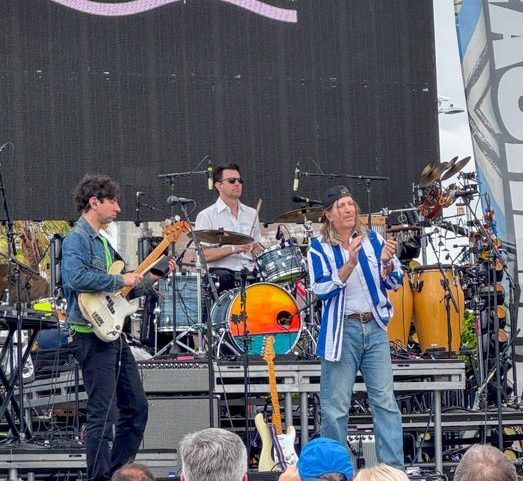
Drummer Vito Roccoforte, who programs much of Poolside’s SPD-SX PRO setup, describes how those elements fit into the bigger picture. “We use all our own samples in it, but the stock sounds are good too. Sometimes we use a kick or the 808, but Poolside has such a specific sound. So, we kind of built that,” he said.
Beyond the primary hits, the SPD fills in the details that bring the arrangement to life. “It’s like really basic stuff—claps, snaps, little percussion things—but when you hear the playback, you’re like, I missed that snap,” Paradise interjects. “Everyone’s hands are busy, so the SPD fills that in.”
The system is also designed for flexibility on the road. “It’s so easy to back up,” Roccoforte adds. “If we’re flying, we can just bring a USB, use a backline, and everything’s there.”
Reinterpreting the Record
What began as a goal of precision has evolved into something more interpretive for Poolside’s lives shows. “We used to try to make performances sound exactly like the record,” Paradise says. “Now, it’s whatever sounds better live, which might be better than the record.”
Keyboardist Casey Butler plays a key role in that translation, navigating the balance between fidelity and expression. “With Poolside music, there’s a kind of identity with the sounds. It’s not just a sound; it’s like there’s a specific element going on. I feel like I know what Jeff’s going for.”
At the same time, working with modern instruments creates new possibilities. “We just got a JUNO-D6, and it’s a little bit more tailored for replicating the record’s sound,”
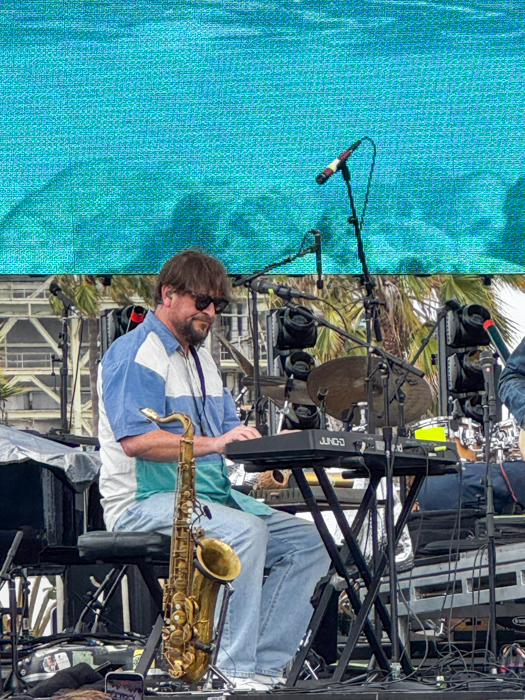
Butler says. “You can really refine it. Whereas analog synths are a little more of a wild beast. You can capture the feeling, but it’s still kind of wild.”
That freedom often leads to unexpected outcomes. “He’s got sounds now where I’m like, this is actually better than the record,” Paradise adds.
"I feel like songs want to become something. You’re trying to let them grow."
Jeffrey Paradise
Collaboration as Process
Collaborations can be key to taking a track from ideation to completion. One thing that stands out is how fluid and instinctive Paradise makes his creative process sound. There’s rarely a strict formula. “It’s always a bit different,” he says, reflecting on the wide range of artists he’s worked with over the years.
While he enjoys remote collaborations when they happen naturally, his favorite experiences still come from being in the room with people and building songs together in real time. “That’s sort of my favorite,” he explains. “Maybe you have a little skeleton of a song already, but you’re kind of working together in real time.”
That spontaneity was slightly different with Slenderbodies, with whom Paradise collaborated virtually. In that case, the instrumental track was already mostly complete before the duo stepped in and added vocals and melodies. Even from a distance, the chemistry was immediate. “They’re really good,” he says. “I was very impressed with what they did.”
What started as a remote collaboration became a real friendship. Since then, they’ve shared bills together, and because the duo is based in San Diego, where Paradise’s parents live, the relationship eventually extended beyond music. “One of them came over to my parents’ house for a little barbecue,” he laughs. “Nice guys. And I really like their songwriting.”
For Paradise, collaboration often begins when a song reaches a creative impasse. There’s clearly something special buried inside it, but the final shape is just out of reach. “Frequently if I collaborate, I’m like, ‘I can’t get this right,’” he admits. “There’s something special in here, and I’m sort of stuck.”
He describes songwriting almost as a process of discovery rather than construction. “I feel like songs want to become something,” he says. “You’re trying to let them grow. In some ways, you’re getting out of the way, and in some ways, you’re adding stuff.” Sometimes another artist can hear that missing piece. “Other people step in and make it happen,” he says. “Or not.”
"It’s always nice to work with people—get in a room and see what happens."
Jeffrey paradise
That tension between inspiration and completion is something Paradise returns to repeatedly when discussing collaboration. “A lot of music is just like a puzzle,” he explains. “There’s a creative seed where you feel like you’re making something, but then to get from like 90 percent done to 100 percent done, there’s this whole other process.”
It’s a process he genuinely enjoys. “I like that part,” he says with a laugh. “Except for when I get stuck. I hate it. Then you’re just banging your head against the wall sometimes.”
Ironically, music originally represented an escape from a desk. “I got into music in the first place because I was like, ‘I’m not cut out for an office job. I don’t want to stare at a computer all day. I don’t want to just be alone in a cubicle.’” He pauses before joking, “Now I stare at a computer in a cubicle—but I do music.”
That’s why collaboration remains such an important part of the process for him. “It’s always nice to work with people—get in a room and see what happens,” he says. One of those ongoing creative relationships is with Ben Browning of Cut Copy, someone Paradise considers both a close friend and a natural collaborator because of their shared musical taste. Their sessions often begin casually, with unfinished fragments and loose ideas, before evolving organically into something complete.
Even the gear becomes part of the story. Laughing, Paradise recalls Browning owning a broken synth that produces sounds they could never intentionally recreate. “Don’t fix it,” he remembers telling Browning. “It’s so cool. You could not program it to sound that cool.”
Remix Logic
In addition to Poolside’s original music, Paradise has made a name for himself remixing under the Poolside (DJ Set) moniker. “I have a DJ mentality,” he explains. “When I listen to music, I’m already thinking, ‘What would I do differently?’” Because of that instinct, the remix process comes surprisingly naturally to him. Once he receives the stems and vocal files from another artist, he says the process becomes almost immediate. “I’m just doing what I would do,” he says. “So, it’s pretty logical to me.”
That approach is also heavily shaped by Poolside’s unmistakable sonic identity. Paradise knows exactly what fits within that world and what doesn’t. “Poolside does have a pretty unique sound,” he says. “I kind of just listen to what the main thing is. If the vocals feel like they could fit on a Poolside song, then I can do a remix. But if they wouldn’t, then I’m just like, ‘I can’t.’”
That creative selectiveness led to one of his more memorable remix stories involving Billy Idol. Paradise was initially approached to remix tracks tied to an anniversary release, including “Dancing with Myself,” but he immediately felt disconnected from the material being offered.
While his team encouraged him to take the opportunity simply because of Idol’s stature, Paradise resisted. “They were all like, ‘Dude, this is a big deal. It’s Billy Idol,’” he recalls with a laugh. “But I listened to the whole album and thought, ‘There’s not one song on here I can do a good remix of.’”
Rather than forcing something uninspired, Paradise pushed for the one song he felt genuinely connected to: “Eyes Without a Face.” “I was like, ‘That’s the perfect Poolside vibe,’” he says. At the time, the answer was no. The song wasn’t part of the campaign they were working on, and the remix never happened. “My team was all like, ‘Dude, you’re crazy. You’re getting paid to do this. Just do it.’”
Two years later, though, the opportunity unexpectedly resurfaced when Idol’s camp returned and asked whether Paradise still wanted to remix “Eyes Without a Face.” His response was immediate. “I was like, ‘Yes. I’ll do it for free. I love that song.’” The end result became one of the remixes he’s most proud of.
Part of what makes remixing efficient for Paradise is that he already has a clearly defined sonic palette he can pull from instinctively. Many of those sounds, he notes, are rooted in classic Roland gear and textures that have become synonymous with the Poolside sound, including shimmering arpeggios, soft synth pads, disco-inspired percussion, and vintage drum tones. “It’s kind of easy to plug in the things I like,” he says. “Little arpeggios, pads, little Simmons box disco toms.”
Because of that familiarity, the framework of a remix tends to come together quickly. “I can usually put together what a remix is going to sound like in two hours, maybe less,” he explains. The initial version may only be a demo, but once the vocal fits naturally into his world, the direction becomes obvious almost instantly. “If the vocal is manageable, I can get it together pretty fast,” he says. “So, I like them in that way.”
Keeping It Real
When asked what he wants the listener to take away from his music, Paradise resists giving a conventional answer. “If I start thinking about what people want, I start hating my job,” he admits.
Instead, his focus remains inward—on the act of creation and performance itself. “All I really care about is putting something real on stage that came from me as vulnerably as I can.” The result is left open-ended. “If people take something away from it, that’s great. If they don’t, that’s fine. I didn’t think anyone would take anything away from it originally, and that’s what people resonated with.”