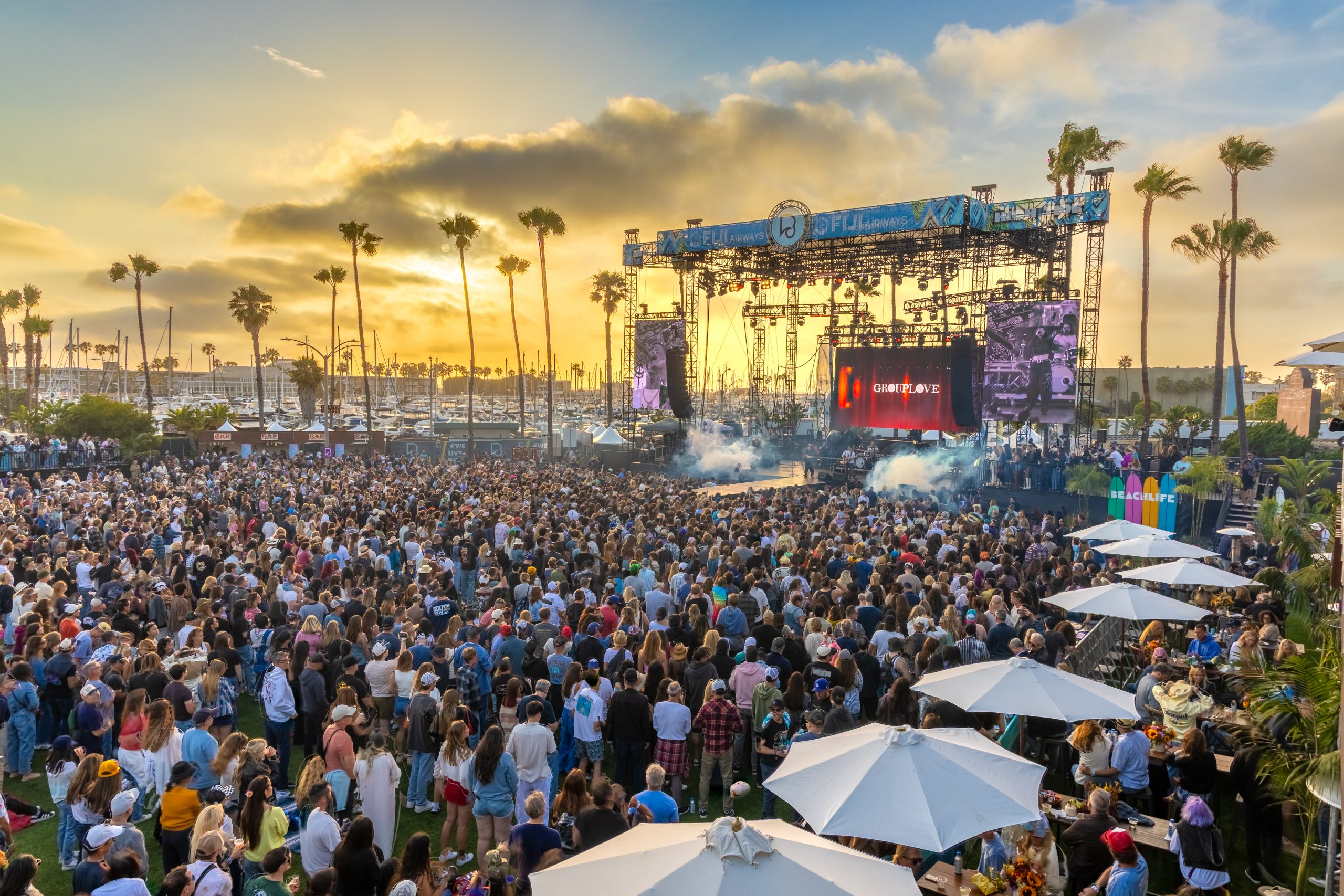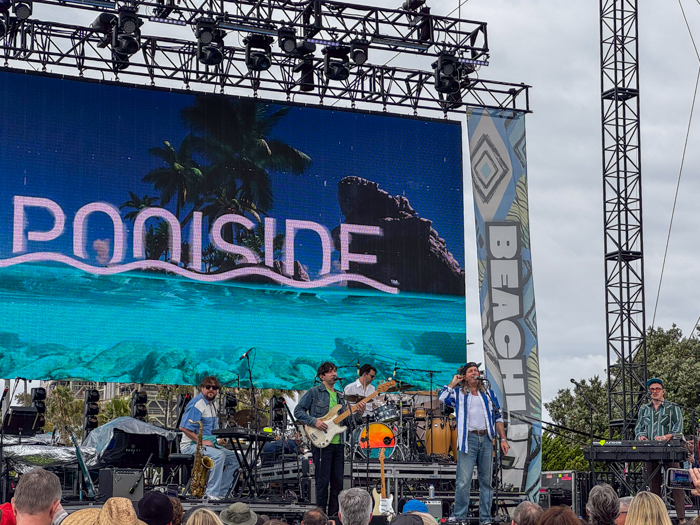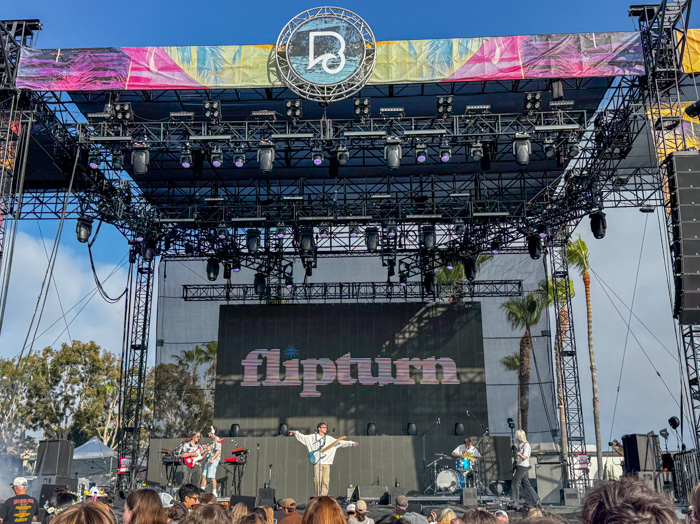


From an appearance on Jimmy Kimmel Live! to sharing a stage with Noah Kahan and a slew of festival dates, the name flipturn is being uttered from coast to coast. The buzzworthy band has built a loyal following thanks to their road-warrior touring schedule and the tight-knit indie scene.
Mitch Fountain plays a key role on both synths and guitar, contributing to the band’s signature dreamlike sound. Hours before their BeachLife Festival set, Fountain sat down to discuss the happy accident that inspired a Roland-forward hit single, the transition from guitar to keys, and the importance of perpetual learning.
Crash Landing
Your latest album has a single, “Juno.” You told a great story online about how dropping your JUNO accidentally created the arp for that song. Can you walk us through how that happened?
I’d just gotten the JU-06A synth Boutique from Sweetwater. We were at a writing retreat in the Carolinas, set everything up, and I put the Boutique on a table. We went to hang out on the patio, and I guess the table was just a little unstable. The keyboard literally fell on the ground. I heard something crash, ran back, and thought, “Oh my god, I literally just got this thing. I swear, if anything’s broken…”
But luckily, I picked it up, and it was totally fine. I pressed a few keys just to make sure everything worked—and the patch you hear in “Juno” is actually that sound. I remember thinking, “This is a really cool patch. What the heck? This literally just fell in my lap.”
We wrote “Juno” within the next two hours. We took that patch and said, “Alright, let’s make a song out of this.” It hit the chordal function on the stem and played this wide major‑7th chord. We moved those chords around, and that’s how “Juno” was born.
Has that experience changed the way you experiment with synths or embrace unpredictability in your writing process?
Absolutely—that’s what’s so cool about synthesizers in general. They’re unpredictable, and they’re incredibly inspiring. Every keyboard has its own distinctive sound. You play a JUNO‑60 or a 106, and while they’re similar, they’re also completely different. That unpredictability really shapes how you approach songwriting.
Beyond making your own patches, it’s also fun to reverse‑engineer sounds. You might listen to a Passion Pit song and think, “I love this—how did they make that patch?” You start recreating it, and in the process, you stumble on new sounds you’d never find otherwise.
I did that a lot with Passion Pit, Foster the People, and MGMT—bands that use really iconic synth sounds. Reverse‑engineering their patches always led me to something unexpected and cool.
Flipping the Script
flipturn recently released Burnout Days (Reimagined) with a lot of collaborators. What was that process like?
It was really fun. A lot of close friends were involved—Winyah did “Inner Wave,” mercury did “Right?”—and everyone was immediately down. We basically just handed the songs over and said, “Do whatever you want.” There wasn’t much guidance at all. We were genuinely excited to see what people would create, and everyone came back with totally different takes.
I actually remixed “Juno” myself. I’d always heard it as something more electronic, and the JU‑06A is great for that chord‑stabby sound—it works really well for more house‑leaning stuff. I wanted to push it further into that world, really grounding it in the JUNO sound. Seeing everyone reinterpret the record in their own way was a blast.
You DJ as well, right?
Yeah, for fun. The goal one day would be to do something like Bonobo—bringing gear out, clocking everything through Ableton or a similar setup. The Boutique synths are especially cool because you can link and stack them. I only have the JU-06A right now, but the TR-08 and TR-09 Boutiques are amazing. I’ve seen videos of people linking them up—it’s such a sick setup.
Reason to Pretend
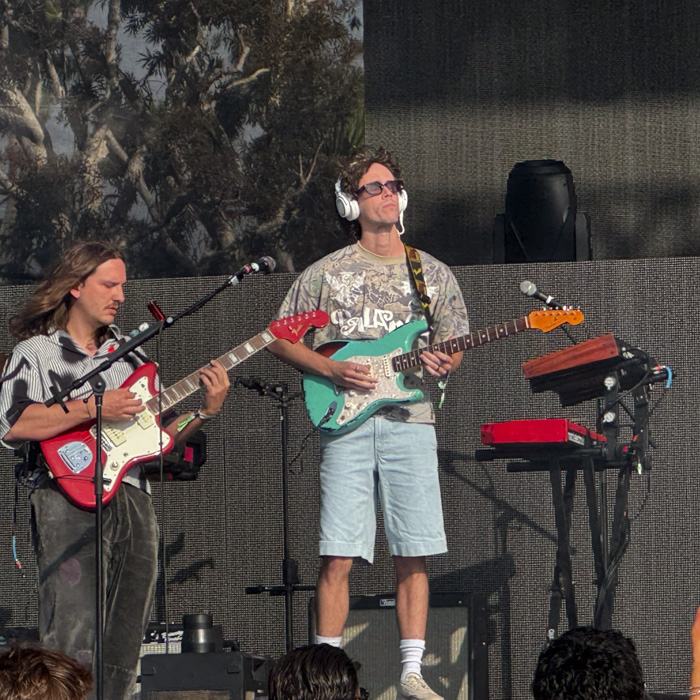
You also play guitar. Do you consider keys or guitar your primary instrument?
Guitar was my first love. I started playing when I was eight. The band actually started in high school, and I joined in early college—they’d been around for about three years already. I’ve been in the band for seven years now.
When I joined, they already had a keys player, but she left. I was close friends with Tristan, and I basically said, “Hey, I can play keys.” That was a lie. I’d never played keys in my life. But I wanted to tour, and flipturn was the only band I knew that was really doing that.
I transferred my guitar knowledge over. Guitar is very linear—you can visualize intervals and movement easily—and that helped a lot. I’m still learning the technical side of keyboard playing, but that’s why I love synths so much. They’re more about sound design. You can bend them into something wild, and it opens up a whole new creative world. I love both instruments now.
How long did it take you to get up to speed on keys?
Honestly? My first show playing keys with flipturn was a sold‑out House of Blues opening for Motion City Soundtrack. I didn’t even understand how keyboard monitoring worked. With a guitar, you’ve got an amp right next to you—but keys go straight to the house.
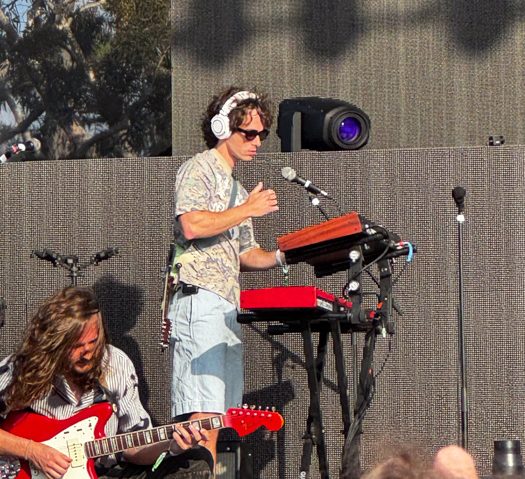
I remember playing the show and not hearing myself at all. It was completely new territory. But I practiced the existing songs nonstop and learned as fast as I could. I’m way better now than I was then, and I’ll be better a year from now. Music is constant learning—that’s what makes it so fun.
"Synths are amazing for layering and filling space without being intrusive."
How do you decide whether a song calls for guitar or keys?
It depends on the space. I’m a huge rhythm player—I grew up playing gospel, soul, and blues—so supporting the groove is always my focus. Synths are amazing for layering and filling space without being intrusive.
For example, in “Juno,” the arps subtly push you into the next section. That’s the mindset: How can I fill the cracks? How can I create movement without stepping too far forward? Whether that’s guitar or keys really depends on the moment.
"I love rebuilding patches on physical gear when I can. It keeps me learning instead of playing the same patches every night."
Hitting the Road
You have a summer full of festivals, including BeachLife, and you’re headlining Red Rocks next month. Does your setup change between festivals and headline shows?
The main difference is the setlist. I use the JU‑06A for “Juno” and “Rodeo Clown,” plus other synths for different songs, and I always have backups ready.
For Red Rocks, maybe bringing in a JUNO‑60 as backline so I can access different sounds. It also depends on prep time—sometimes software synths are faster, but I love rebuilding patches on physical gear when I can. It keeps me learning instead of playing the same patches every night.
Festivals often mean shorter sets and quicker transitions. How do you make a strong first impression and build momentum for new listeners?
Captivating the audience is everything. Smooth transitions are crucial. We think about our sets almost like DJs. There’s no dead air; everything flows. We use synths to create intros, walk‑on tracks, and transitions. Tonight, for example, we have a custom walk‑on to “Inner Wave,” and the set moves seamlessly from there.
If you had a Roland wish list, what’s at the top?
The TR-1000. That thing is sick! I see it everywhere, and it looks so cool. I saw SG Lewis just got one in his studio. A 909—hands down, that’s the coolest drum machine ever. I love the 808 too, but the 909 is my favorite.
A JUNO‑60 or a JUPITER would be amazing. I love vintage gear. The Boutiques like the TR‑09 and SH‑01A are also incredible. You can link them up, and they sound insane. I’ve got a massive wish list. I’d go bankrupt if I bought everything I wanted.