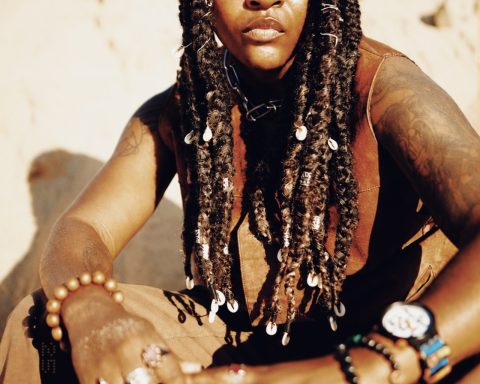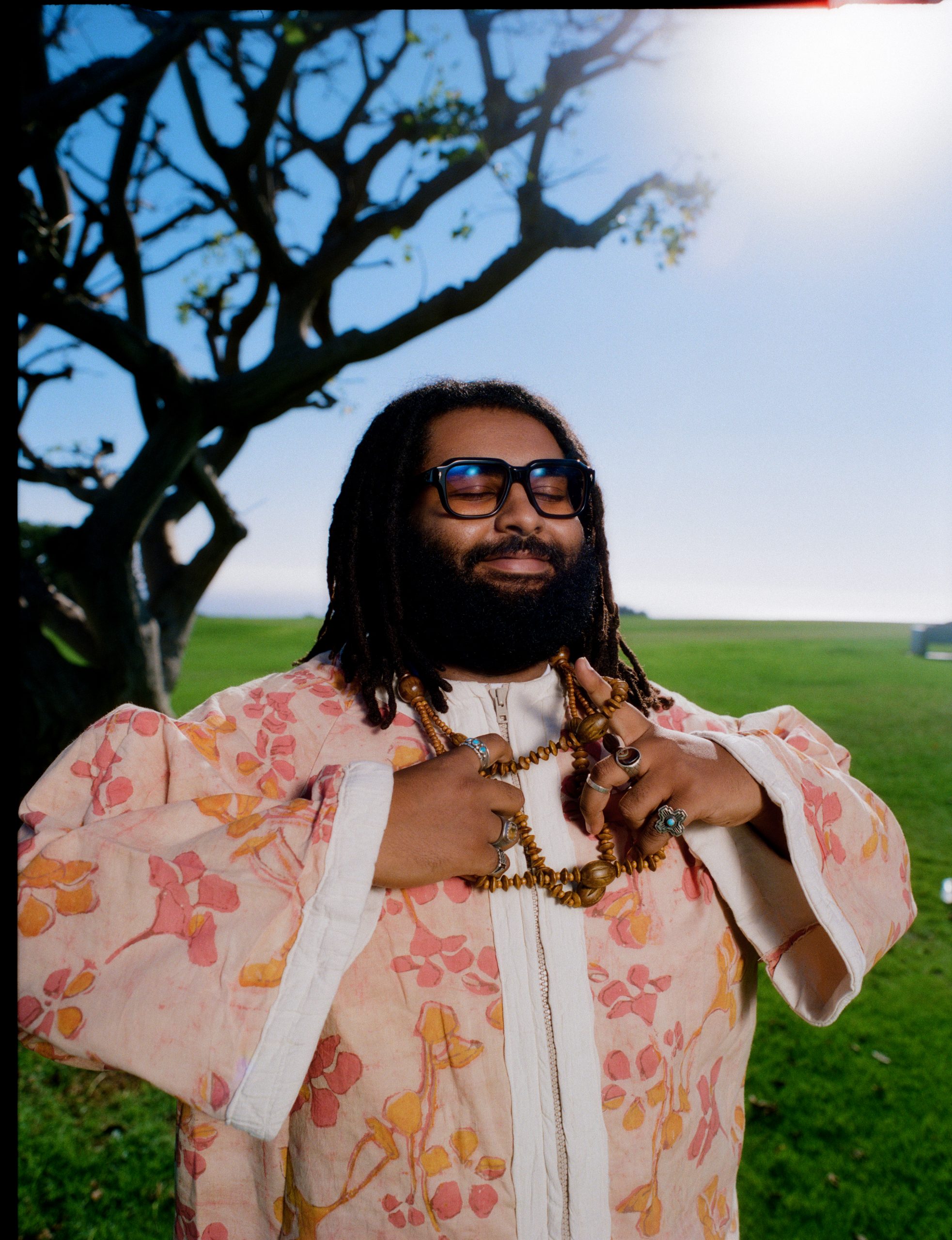


25-year-old Elmiene is a time traveler. The precocious singer-songwriter never recorded a single song or played a single instrument before mesmerizing people in 2021 with a viral rendition of D’Angelo’s “Untitled (How Does It Feel?)” that sounded both nostalgic and new. His gossamer voice on songs like “Reclusive,” “Cry Against The Wind,” and “Honour” from his debut album sounds for someone reminds you of how delicate intentionality is, like tuning a radio to the precise frequency needed to connect with thousands of people’s hearts at the same time. The depth of his musical knowledge belies his age and produces music that Gen Z vibes to and that older music legends want to help grow.
“As soon as I met Raphael [Saadiq], got comfortable with him and went to his studio, I met No I.D., and we developed a good working relationship. Salaam Remi is another one of my heroes who is really important in my artistry. He really helped me with my songwriting,” he says.
The Roland JD-800 was key to the earthy tonality of ’90s R&B and neo-soul, and essential to the sound of the British genius’s impressive new album. But he can tell you how his music transcends space and time better than anyone else can.
Student of the Greats
Your music sounds nostalgic for the past R&B but also connected to the future. How do you feel like your music marries both?
I think what marries both eras is my obsession, within my heart, for a certain era—Stevie [Wonder], Prince, D’Angelo, Donny Hathaway. That’s the era that I think is perfect, sonically. But I was born in 2001. I’ve been influenced by osmosis through being around pop music and pop culture of the 2010s and 2020s. Inevitably, it has become a part of me. I’m honest with myself, and I write music from within me, with the ’70s and all that being my core, but I also understand that I don’t want to make that again. I’m not here to make a kind of pastiche, recreation of Songs In The Key of Life or Music of My Mind. I’m really not trying to do that.
You’ve said before that you draw from the pool of inspiration of legends like Stevie Wonder, Sly and the Family Stone, and D’Angelo when working on music in the studio. How does that work in the studio? Is it you measuring what you just made up to what they did? Is it pressure?
All the melodies that come out of my mouth come from that world. I feel like my way of feeling comfortable with myself is knowing that none of my melodies are original. 20% might be from Sly that day, 30% might be from Stevie, 40% might be from [D’Angelo]. I accept that. Within that, it’s the story and the songwriting of where the perspective comes from within me, which kind of bridges the two gaps together. I know my melodies, and the musicality of it is coming from them. But the story is mine and mine alone. No one else has lived this life.
"All the best songs I've ever written have been moments where the desire to complete a song, and the message within it, in the most honest and articulate way possible, is the only driving point."
All the best songs that I’ve ever written have been moments where the desire just to finish and complete a song, and the message within it, in the most honest and articulate way possible, is the only driving point. They’re always ones where I feel like I’m reaching some sort of originality. If I’m comparing, that means I’m not viewing this music as living up to a certain standard, ’cause I need to compare it to something else. It’s not strong enough on its own legs to exist; I need to put it in the perspective of a Prince song. But if I’m obsessing over a song I made to the point where I forget Prince even exists, I’m doing something.
The Roland Connection To The Past
Legends like Stevie Wonder and Marvin Gaye used Roland to shape their sonic journeys. What is your earliest memory of working with Roland products?
The JD-800. When I was working with Raphael Saadiq, he pointed to the JD-800 and said, “You know I did ‘Lady’ on that. The bassline from ‘Lady’ isn’t even a live bass; it’s the JD-800. Then, No I.D. turned around and said, “We’re gonna take your album (sounds for someone)—every song, every part of it that you feel like needs to be replayed, and we’re gonna replay it on that. The JD-800 is gonna be the fabric of this album.” It sounds like I’m making up, but it’s true. That ended up becoming the sound fabric of it all.
I told my producer, Amir, “You’re gonna replay some of your lines on this, and we’re gonna find the right sound.” The JD-800 is all of the ’90s sounds: Donell Jones and all of them. That was part of their fabric. So, if we take the JD-800, with the songwriting being where it is, and kind of cement it with these sounds that are familiar to the ear, we’re gonna have something special.
I love that you’re pulling from the past but putting yourself on top of it.
You have to. You have to always overpower your tech. The software can’t be the leading thing. The leading thing people should come for shouldn’t be them recognizing a synth. That could be a nice candy part of it. When they’re coming to hear what you have to say, you’ve won; there’s nothing else to worry about. That’s why Stevie can go from the ’60s Motown sound to the ’70s era of Songs in the Key of Life, Innervisions, Music of my Mind, and Talking Book, into the ’80s, where he’s playing whole different instruments, into the ’90s with “These Three Words” and that whole Jungle Fever soundtrack. That’s artistry.
"When they're coming to hear what you have to say, you’ve won; there's nothing else to worry about."
You said Roland is the thread of the album. Is there a song where you can hear the Roland influence?
On the pre-chorus of “Reclusive.” That song, for a while, felt really weak to me. Something was missing. The song was always the same. It didn’t hit. I didn’t really like the song at all. It wasn’t gonna make the album. It was my managers and everyone around me who really pushed me to release it. For a while, I was like, “Get out, I don’t want this.”
There was also a part of it where I couldn’t even get around why people would care about me talking about my daily routine. It feels mad. In the end, many people did because they related to it. The thing that pushed me over the edge to really loving the song was in the pre-chorus, there’s a sound in the back, which is like this really hard piano that really smacks with every chord like a drum. That was from the JD-800. It gave it that hard-hitting feel where I was like, “Whoa, we’re in it.” It was like another percussion. “Reclusive” felt really soft before that.
"There's a sound in the back, which is like this really hard piano that really smacks with every chord like a drum. That was from the JD-800."
Search For Perfection
Sonically, what do you want to achieve in your career?
I want to write a song as good as Stevie Wonder’s “Happy Birthday.” If I do that, I’m good. I want to make a song as simple and genius as “Happy Birthday” and “Isn’t She Lovely.” I think those are the greatest songs. They’re just so basic. They’re the best.