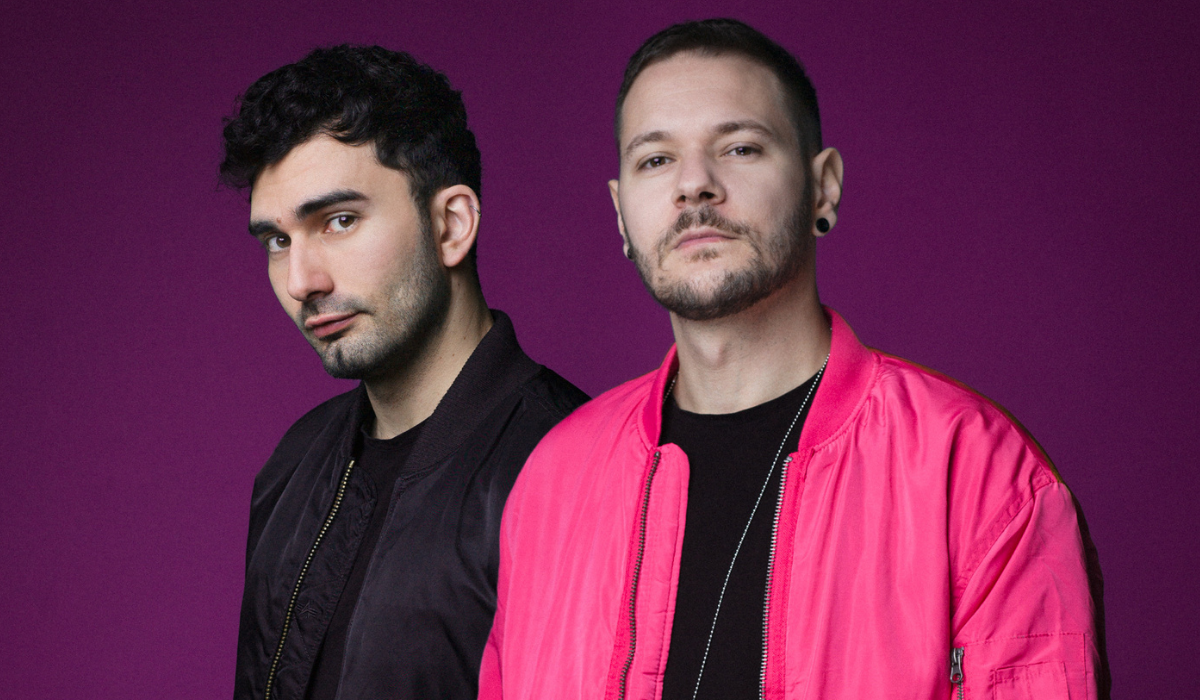


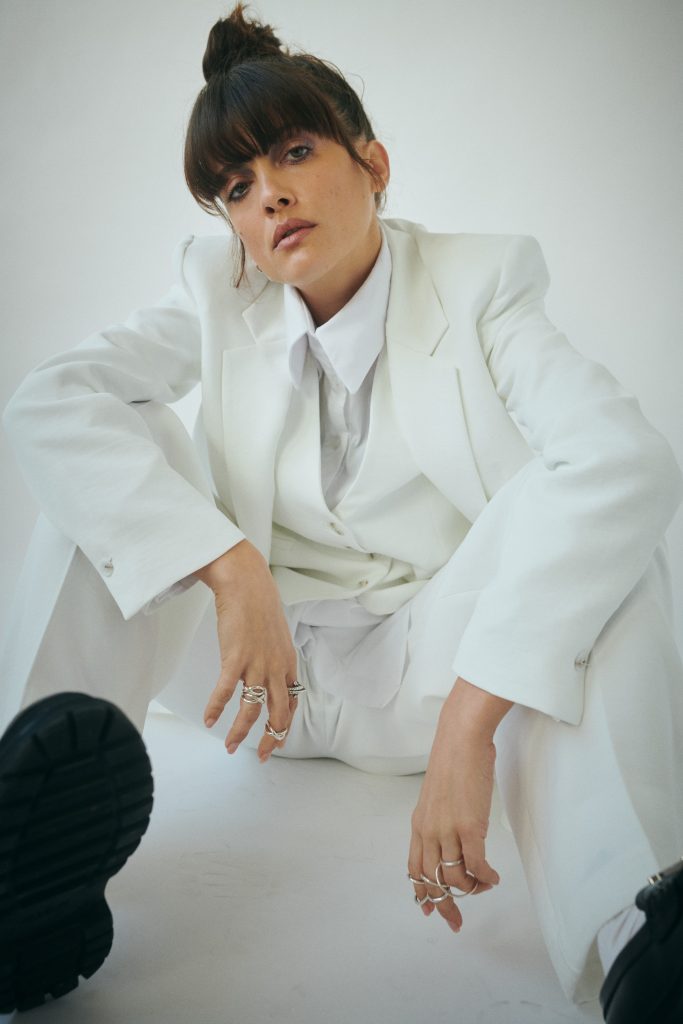
There’s a bright sun burning above the graffiti walls and market spice smells in the south Florentin neighborhood of Tel-Aviv. Here, two artists have lived and loved while crafting their music. With the release of their sophomore LP, KIDS, Noga Erez and Ori Rousso completed a three-year journey. It was an experience filled with introspection, creative intention, and honest expression. The resulting record overflows with electricity and authenticity.

Since the 2017 release of Erez’s debut LP Off the Radar, she’s been turning heads with her electronic-tinged production and evocative voice.
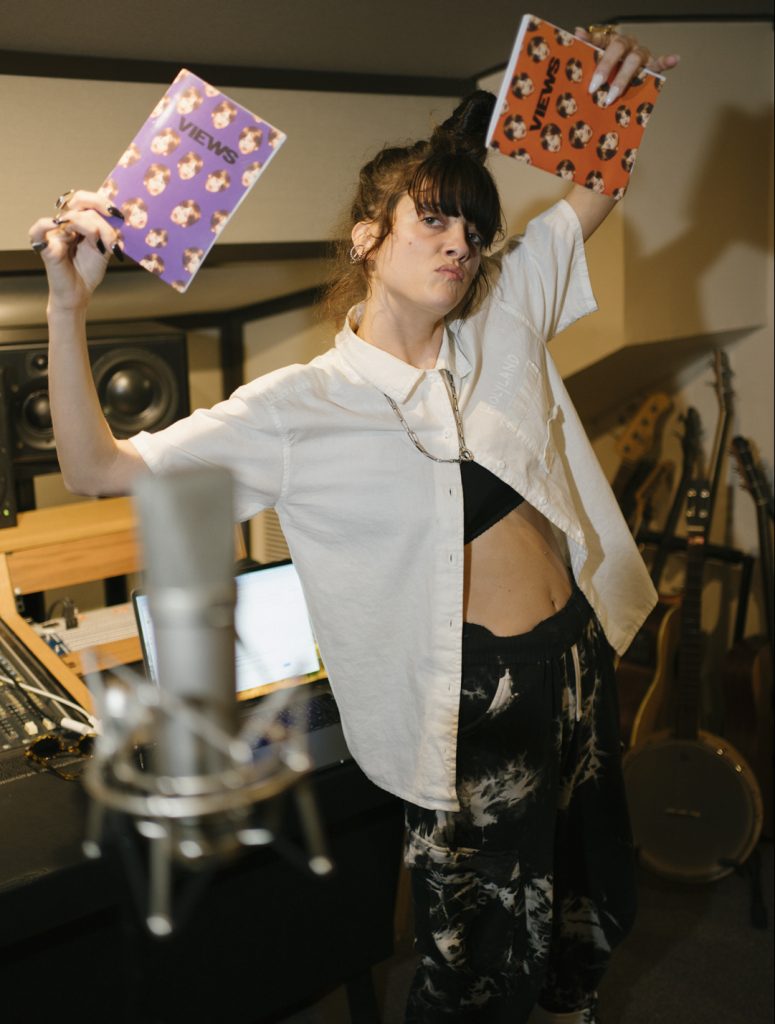
“Views,” the first single from KIDS, features long-time producer and life partner Rousso. It’s a new sound for Erez. The track is replete with sticky hooks, precise production, and beefy low end. It’s an immediate glimpse into the singer’s deepening embrace of rap vocabulary. The song’s video, directed by collaborator Indy Hait, is a captivating visual story elevating the narrative.
Erez and Rousso live in a bohemian art loft that emanates warmth and artistry. It’s within walking distance of cafes, restaurants, and their studio. Here in Florentin, the duo conceived, composed, developed, and honed KIDS.
"Ori and I have been working together for many years. Everything blends together—there aren’t any boundaries."
We Are All Just Kids
Passion fuels hard work, but is Erez exhausted by the rapid pace of her ascent? “No, I’m at that sweet spot between tired,excited, and overwhelmed,” she shares. “It all meets in the middle. I’m doing what I’ve been wanting to do my entire life so I can’t feel tired.”
Asked about the genesis of their creative partnership, Erez is clear. “Ori and I have been working together for many years and are life partners as well,” she reveals. “Everything blends together—there aren’t any boundaries.”
Rousso is often credited as a featured artist on many of the album’s tracks. “It came naturally. Ori sometimes comes up with something so genius that his voice is the only fit. We used to give up on those things,” Erez says. “But why replace a sound if we have a voice that sings it perfectly.”
Ori drops a zinger. “Most people thought I was a sample.” Throughout the LP, with its tasteful intricacies, these “Rousso” hooks pepper and punctuate the songs.
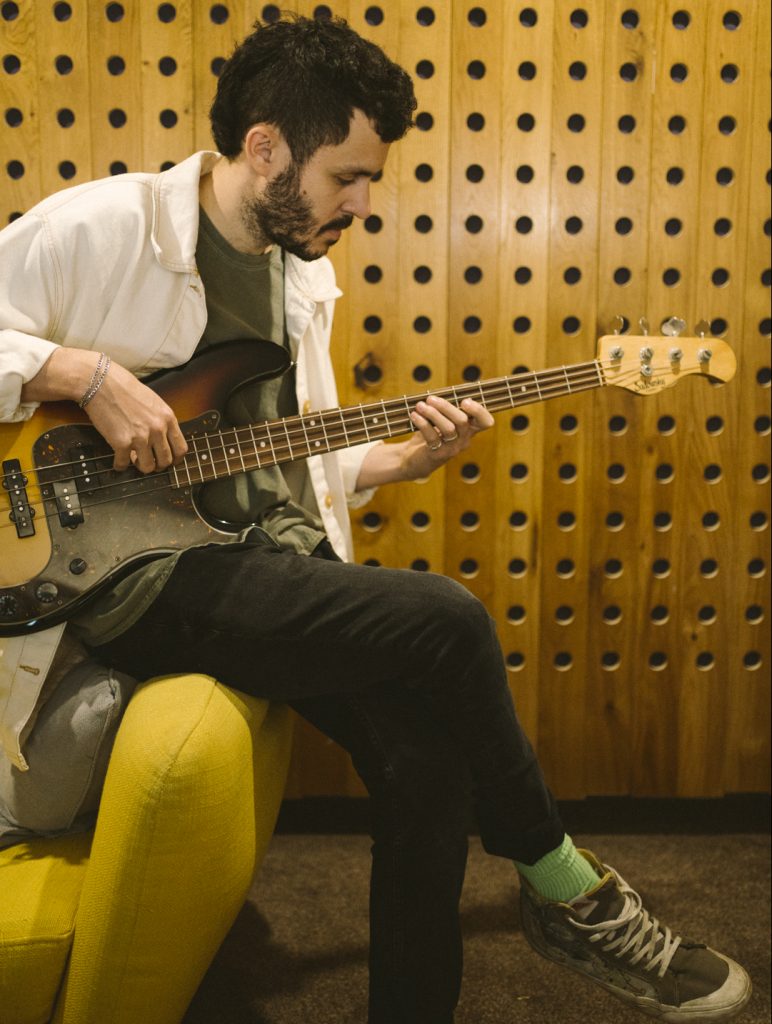
Creativity itself is an unbreakable bond, helping the pair navigate their relationship. Rousso is the quiet producer, bass line master, and beat-maker. Erez is the top line, fierce listener, and narrative hunter. Together they blend, edit, and prepare the ingredients to cook the hooks.

"We added some magic to a song we would have given up on or left unfinished. Music needs time.”
The Power of Names
The process of creating these dynamic songs is as unique as the artists themselves. “‘Cipi’ is the second track but the first song on the album. We had it around for a long time, but the melody was basic and monotonic,” Erez recalls.
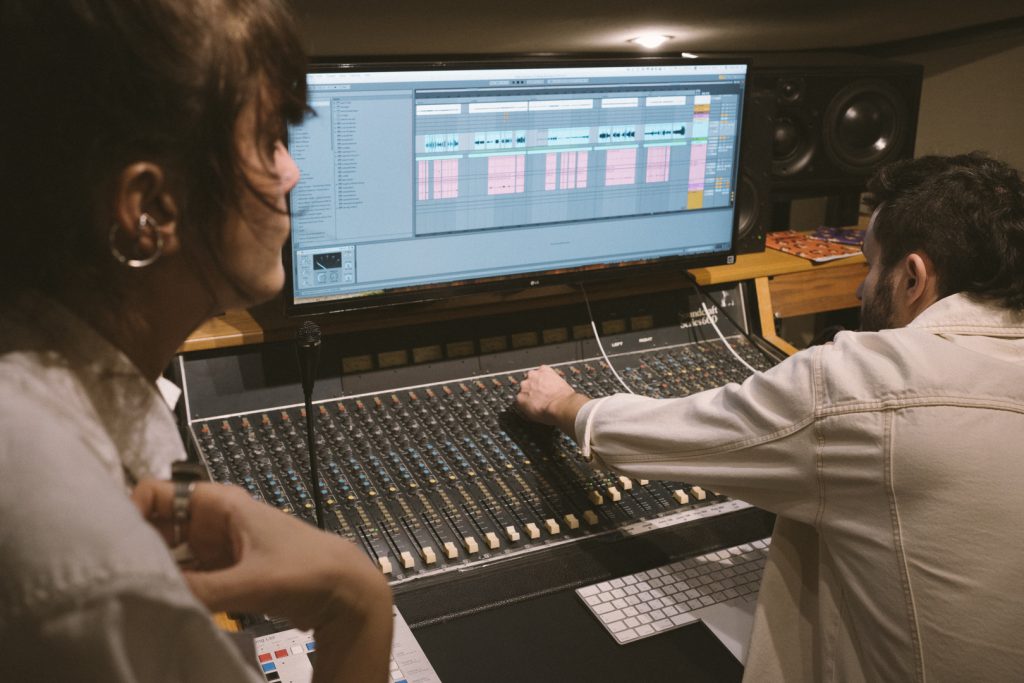
Then, Roussou added an idiosyncratic touch. “I sampled tutorials of different trombones and scales and built a sampler in Ableton.” They now use the sampler frequently. “It’s on five or six songs on the album. We always open it when we begin a new song. That’s how we started ‘Cipi.’”
Defining a palette and using it for cohesive inspiration is valuable. The original trombone samples create a cohesive thread weaving in and out of the tracks on KIDS. Noga agrees. “It became, in a way, the sound of the album,” she says. “Whenever we needed inspiration, we would open that tool and see what happened.”
The origins of the title “Cipi” are also unusual. “We wanted to have a song that used someone’s name. Cipi is a Hebrew name that is short for Tziporah.” There’s a dual meaning, however. “‘Cipi’ is also short for Cipralex, an anti-depressant anti-anxiety medicine,” the singer says. The duality fueled the track. “It started with being someone’s name, and then became a song about using pills to get over mental issues.”
Ori jumps in, “A lot of songs on KIDS began with this approach. Before having a narrative, we thought about names.” The pair looked to a classic like Abbey Road with its evocative titles. “‘Cipi’ came from this inspiration,” Rousso adds. “We had the name and wrote the song.”
Reframing a Pandemic
As the global pandemic reached critical velocity in 2020, Noga Erez had to re-think the typical album release script. In a matter of days, SXSW was postponed, then Coachella got canceled, respectively. Live music went on permanent lockdown.
“We were almost done with the album and about to get into the mixing process,” Erez explains. “But we got an extra year because of the pandemic. Instead of working on new music, we decided to perfect the album we had.”
With the pressure to constantly release new music, some artists drop songs that feel unfinished. With this in mind, KIDS’ deliberateness and attention to detail are remarkable. The song “Knock Out” benefited from the extended gestation period. “I so wanted to pass on ‘Knock Out,'” Erez laughs. “I hated that song.”
Roussou weighs in. “It was hard to fight with her about this. She was so sure that “Knock Out” didn’t need to be on the album.”
In the end, Erez believes reflection and editing made all the difference. “We added some magic to it. We would have given up or left it unfinished. Music needs time.”
"Instead of working on new music, we decided to perfect the album that we had.”
Kids Against the Machine
The duo performs and records acoustic versions of their compositions with an incredible group of musicians. Here, the songs morph into completely new versions of themselves with organic arrangements. They rehearse and record these re-worked versions live off the floor.
“We both saw a version of “What I Like” by Bruno Mars and it’s amazing,” Rousso explains. “It’s a live performance of him with two singers as they pound on a table. It’s super simple but sounds amazing. That inspired us.”
Erez gives some more analysis. “These are better songs than Off the Radar. They could be special if performed acoustically without machines and drums.”
The reimagined versions are both musical and magical. “Both of us came from playing actual instruments and we love this vibe so much,” Rousso says. “They are a true test of the production lines.”
“It took a lot of preparation for Noga and me,” Rousso explains. “We prepared charts and sent them to everyone.” The duo then rehearsed with the full lineup. “These incredible players helped us make our vision come alive. But the vision happened here between the two of us,” Erez says, gently touching her and Rousso’s heads.
Nothing Comes Easy: Rapping, Her Way
On the KIDS LP, Erez employs her rap skills more than ever. Indeed, her rhythmic virtuosity shines all over the record. She’s perfected a distinct and authentic rap style. The acoustic version of “End Of The Road” is a testament to these newfound abilities. Asked whether rapping comes easily, her answer is forthright.
“Ori will hate me for saying this, but I don’t think anything I do comes naturally. I have to kind of grind my way to anything I could call skill.” Rapping was no different. “When it comes to rapping, it was a hidden thing I was doing,” she shares. “But I found it helps me relax when I feel stressed.”
Rousso smiles, again revealing their chemistry. “Ori was my tutor and said, ‘Rapping is your next mission.’ He’s always demanding, in a very loving way, for me to practice harder.”
Authenticity is a critical ingredient when forging a fanbase in today’s new music model. Of Erez’s mad skills, Rousso has nothing but praise. “Noga thinks it’s important to push boundaries,” he says. “We listened to so much hip-hop over the past two years. I was curious to see how she’d sound if she practiced and it’s amazing. Her tone and vibe, they’re something else.”
"We set a certain amount of time. To keep our ears refreshed, we allowed two hours for the final mix of each song."
Live, Breathe, Collaborate
During the extra year due to the pandemic, both Erez and Rousso were instrumental in sculpting the final tracks. “I don’t know if either of us makes the decisions,” he jokes. “It was the hardest two months ever. We stopped living and just focused on the mixes.”
Erez smiles, happy to expand on the process. “We used a bit of a different approach on this record. We set a certain amount of time for each song and would never work beyond that. To keep our ears refreshed, we allowed two hours for a final mix of each song.”
They also kept a close-knit circle of musical confidants close by for KIDS. “We had a lot of new friends, some of whom play with us in the Kids Against the Machine,” Erez says. These include drummer Itamar Lobestein and bassist Matan Egozi.
“Matan is an insane musician. Everything beautiful about the new ‘Knock Out’ is mainly him.” She then smiles and gives kudos to her partner, “Ori is the biggest part of the process. Usually my notes are like, ‘My vocals are not loud enough,’” she jokes. “I’ve been able to sharpen my ideas about mixing and how to talk to sound people about things like EQ and compression.
Rousso affirms the power of their collaboration. “It was amazing. We couldn’t have done it alone.”
Elevating Visuals
Modern music videos can be rife with throwaway content. With Noga Erez, there is thoughtful intention given to the narrative of every clip. The videos are an extension of the songs. “We sent references of videos to directors,” Rousso explains. “We always come back to Kendrick Lamar, Flying Lotus, or Tyler, the Creator.”
Those artists get the blend right. “It’s really hard for us to love a video if it doesn’t pair with the song perfectly,” Rousso adds. “With our first album, it was hard for us to nail that.”
The artist behind their latest videos is Indy Hait. The visionary director is in total sync with Erez and Rousso’s desire for meaningful visual stories that augment a song. “Indy is a genius. We both feel we found the director we want to work with for the rest of our lives.”
“Both of us grew up watching MTV,” Erez shares. “We’re both very specific about what we like and dislike. ‘Views,’ was our idea of an endless staircase and we kind of developed it with Indy.”
The process can work both ways. “‘You So Done’ was completely Indy’s idea,” she says. “We needed to find a way to be minimalistic about the production, instead of pouring enormous amounts of money into something that wouldn’t feel right.”


"Indy is a genius. We both feel we found the director that we want to work with for the rest of our lives."
Erez reveals that the duo put intentional restrictions on themselves. “Our new limitation is we decided we need videos shot in one location. We also want videos people can describe in one line. ‘Have you seen Noga’s video with the endless staircase or Noga’s video with the robot?’”
City Slang for Family
The industry changes fast. As a well-known industry executive said, “The artist owns the relationship with the fans, not the label.” Noga Erez’s label City Slang Records, headquartered in Berlin, is part of a new generation of artist-friendly imprints.
Given their obvious creative freedom, how is their relationship with the label? “City Slang is a family. The owner is a person that we talk with, hang with, drink wine with. Our A&R person has become our manager because of how incredible she is and how invested she became in the project.”
She goes on to praise the label’s ethos. “They of course would love to make money, but they’re not in it for the money. We were able to have success on that end, so we’re happy there is living proof you can do both.”
Furthermore, the label’s willingness to grow with its artists is a blessing. “Artists need time to develop and a home to do it. City Slang has been a family and supporter. It’s way beyond a label.”
Two SPDs and a JUNO Please
Noga Erez released her new LP with a series of streaming shows. “We created this ambitious concept of a performance that has us, the band, and 30 dancers. We made it so people from all over the world will be able to see it on a screen,” she says.
The creative set consists of a giant screen, dolly tracks for 360-degree shots, handheld cameras, and a swinging camera hanging from a rope. The performance uses their tried-and-true instruments for live performance: two Roland SPDs. One is part of Ori’s rig, where he triggers the backing tracks, samples, and plays guitar. The other SPD is for Lobestein. As Noga puts it, “The SPD is our instrument.”
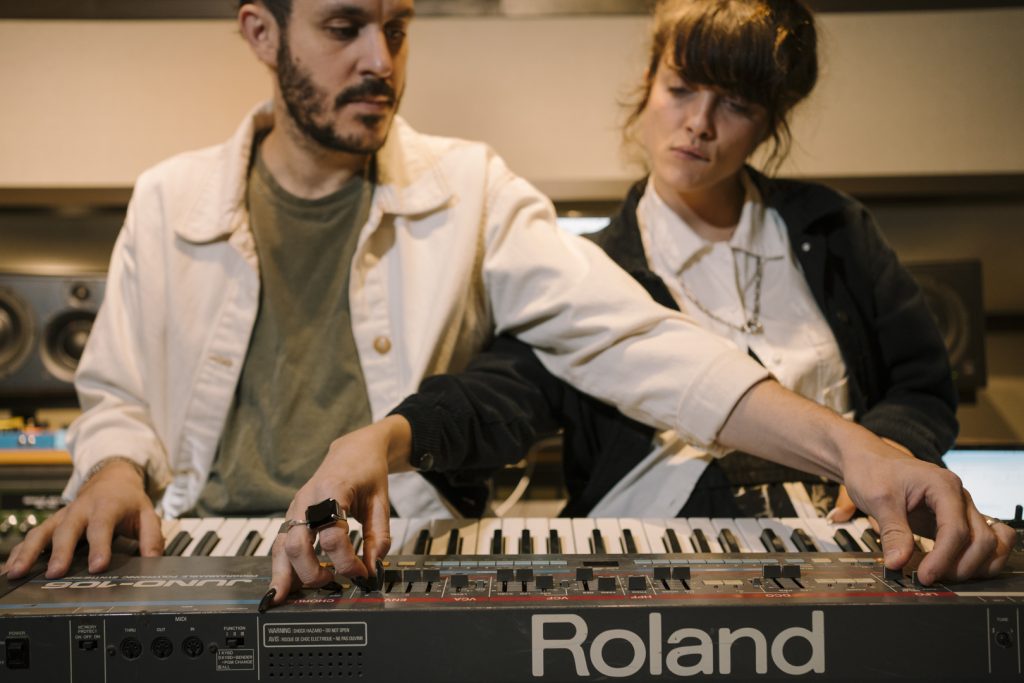
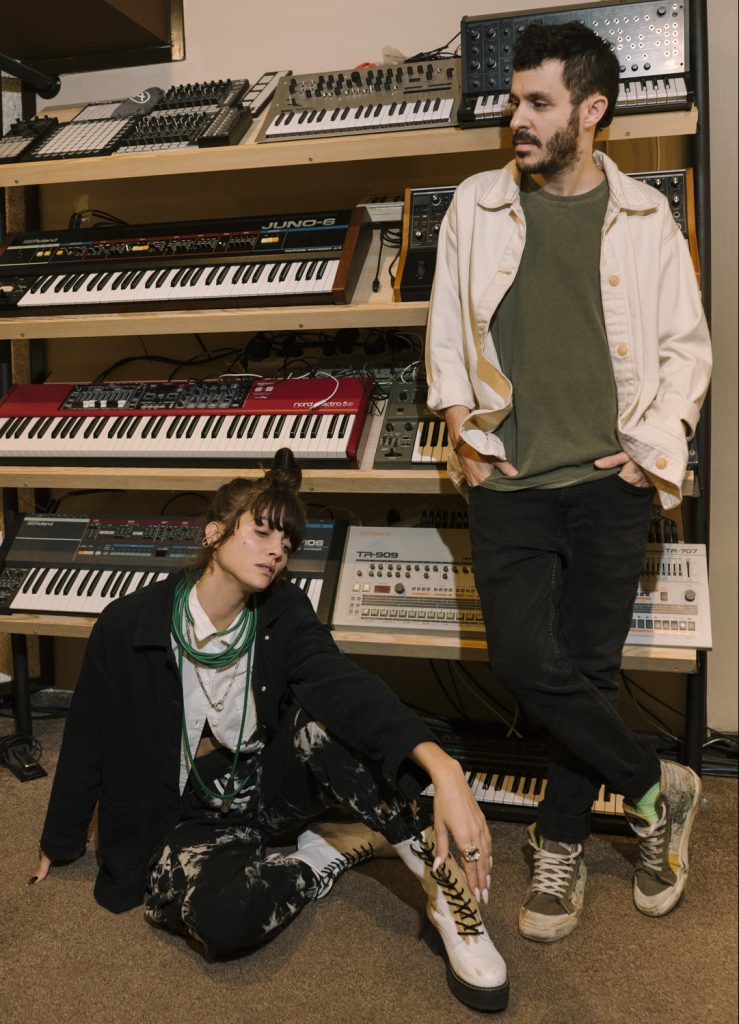
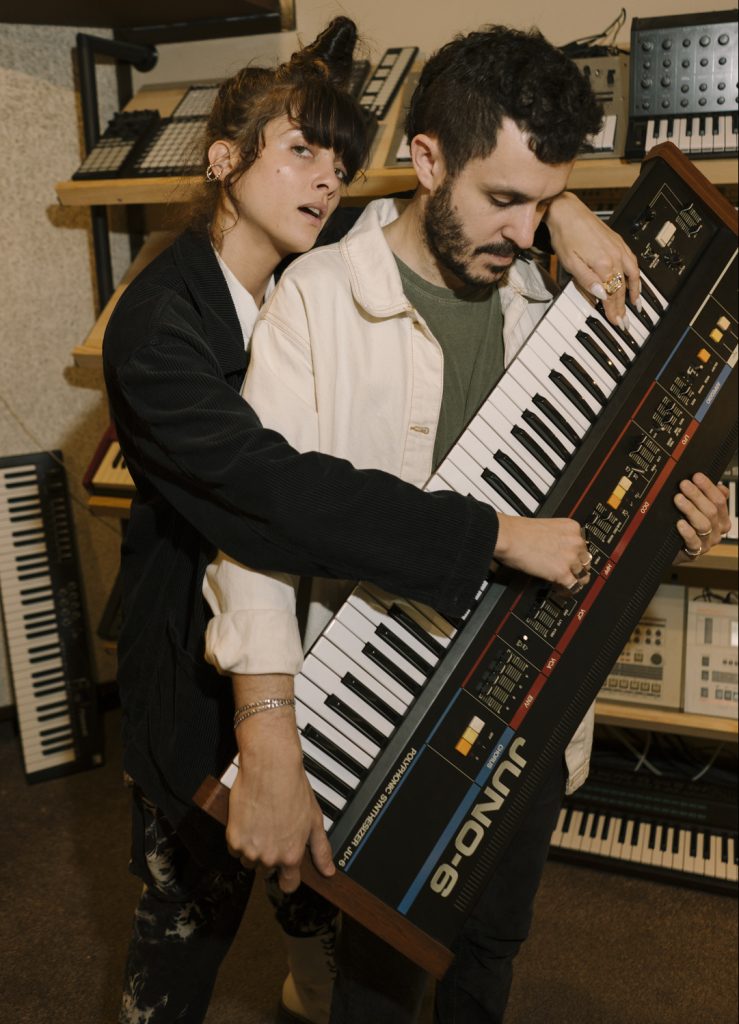
Additionally, synthesizers are prevalent on every track. “We love synths,” Erez exclaims. “The JUNO, I mean that’s the thing.”
"Take care of your mental health as much as you take care of your career."

Rousso opens up about their fondness for the classic Roland analog synth. “The JUNO-106 is on most of the tracks on the album,” he says. “We can’t explain exactly what it does, but it glues everything right away. Every time we use the JUNO, it’s like, ‘OK, there it is.’”
Advice for New Artists
When asked if they have any advice for young artists and producers, the pair present calm and open smiles. “Artists and producers are very different people,” Rousso says.
“You are a different person,” Erez replies affectionately.
“Take care of your mental health as much as you take care of your career,” Erez says, becoming thoughtful and serious. “It doesn’t matter what size artist you are. You might fail and will need to get up after getting punched. If you take care of yourself, you can stand back up.”
Rousso adds his two cents. “It’s really important to be prolific,” he says. “That’s an amazing practice and discipline. Then you can listen to stuff you released and try to improve.” He has a last, unexpected bit of advice. “The best thing is just copying all the time. Copy beats, songs. I copy when I don’t have inspiration”
One would be hard-pressed to find wiser words in pursuing any creative endeavor. For this pair of kids, their honest integrity matches their expressive passion.