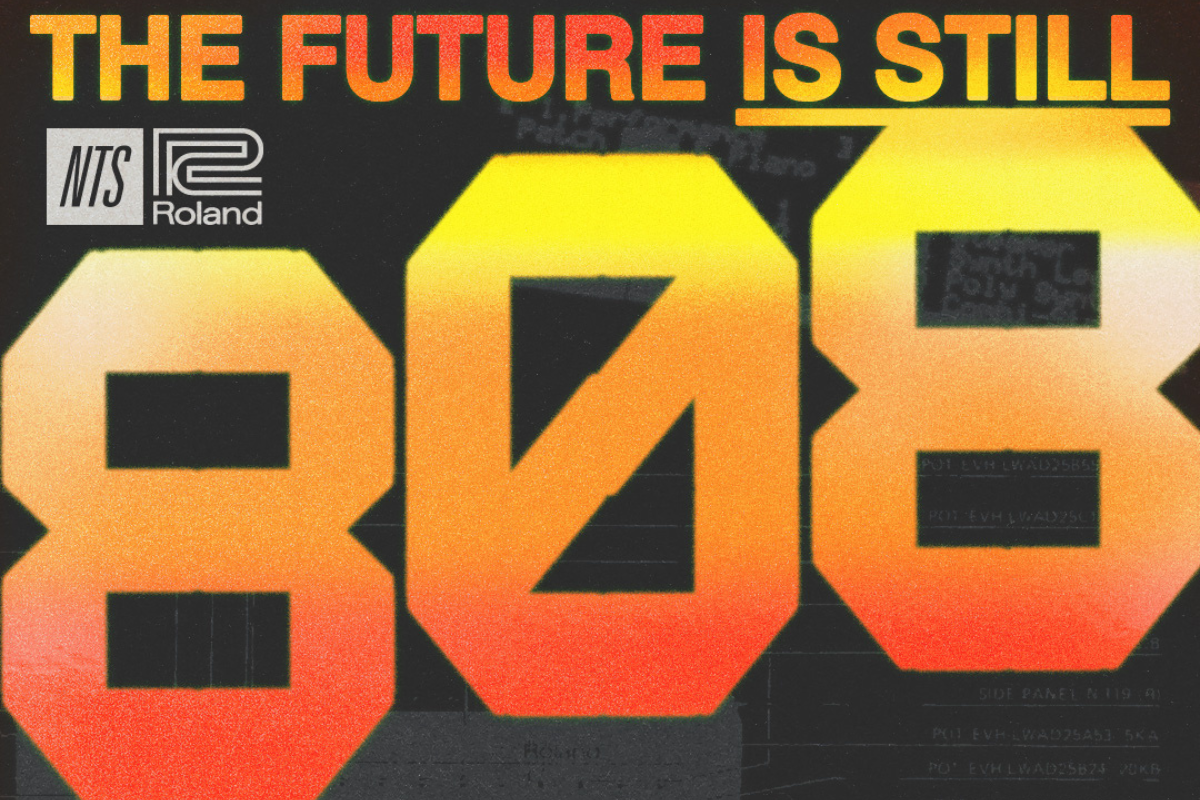
In 1980, a drum machine arrived that the world wasn’t quite ready for. Fast forward to 2026, and the TR-808 hasn’t just survived—it’s redefined what drums sound like. For 808 Day 2026, NTS drops a three-part radio series tracing the TR-808 across continents and cultures, hosted by DJ, producer, and NTS resident Shy One and produced by award-winning documentarian Nick Dwyer.
Over three episodes, follow the 808 from its origins in Japan to the dance floors, studios, and bedrooms where it shaped the birth of house music in Chicago, the rise of techno in Detroit, and scenes across Asia, Europe, South America, and beyond. And the ripples continue to spread—learn how these timeless sounds continue to resurface with new generations, carrying the 808 from its analog origins into the future. Read on to dive into the second phase of the 808’s expanding global influence.
➡️ Listen to The Future is Still 808 here.
Playlist
Clear by Cybotron (1983)
Released in 1983 by the pioneering duo Cybotron, Juan Atkins and Richard Davis, “Clear” wasn’t the first record they made using the Roland TR-808, but it may well have been the most influential.
It’s 1983, and we’re in Detroit. A city built by the automobile industry, Detroit had spent much of the previous decade in decline. Factory closures, automation, unemployment, and population loss had left deep scars across the city. But for a new generation of musicians growing up in Detroit, the future wasn’t something to fear.
No UFOs by Model 500
Inspired by science fiction, Kraftwerk, Parliament-Funkadelic, and Afrofuturism, artists like Juan Atkins began imagining a new relationship between human beings and technology. For Atkins, the Roland TR-808 wasn’t trying to imitate a real drummer. That completely missed the point. He embraced it precisely because it sounded like a machine. Together with Richard Davis, and later as Model 500, he transformed those synthetic rhythms into a new musical language.
On & On by Jesse Saunders (1984)
By the early 1980s, Jesse Saunders was already one of Chicago’s most exciting young DJs, holding a residency at The Playground while making regular visits to Frankie Knuckles at The Warehouse, the club that would soon give an entire genre its name.
Hungry to stand out from the city’s other DJs, Saunders began bringing a Roland TR-808 into the club, programming original rhythms and using the dancefloor itself as his own private laboratory. Then, one night, disaster struck. A rare bootleg disco megamix called “On & On” by MACH, his signature closing record, was stolen from his record box.
Instead of searching for another copy, Saunders decided to make his own. Together with Vince Lawrence, he transformed one of the rhythm tracks he’d been testing on dancefloors into something entirely new. Released on Jes Say Records in January 1984, “On & On” is widely regarded as the first commercially released house music record.
Dirty Talk by Klein + M.B.O (1982)
Rather than recreating the lush sound of 1970s disco, a new generation of Italian producers stripped everything back. Live rhythm sections gave way to drum machines, shimmering synthesizers, and irresistibly melodic hooks. The result was dance music that felt unmistakably futuristic.
One of the genre’s earliest classics arrived in 1982 from Klein + M.B.O, a Milanese production duo. Milan had become one of the world’s fashion capitals, attracting an international crowd whose nightlife was hungry for the same electronic sounds lighting up dancefloors in Chicago and New York.
What made records like this so important wasn’t their success in Italy. They crossed the Atlantic, finding their way into the record boxes of DJs like Frankie Knuckles and Ron Hardy, becoming part of the musical DNA of Chicago’s rapidly evolving dancefloor culture.
Problèmes d’Amour by Alexander Robotnick (1983)
In 1983, another Italian producer took the Roland TR-808 somewhere altogether stranger, creating one of the defining records of Italo disco. Alexander Robotnick thought his album, Problèmes d’Amour, was a failure. Like many of the producers making Italo disco at the time, he had no idea these records were finding audiences beyond Italy, becoming DJ favorites in Chicago and Manchester.
Much like Roland’s own view of the TR-808, he assumed he’d created something that hadn’t found an audience. It wasn’t until almost twenty years later, with the rise of the internet, that he realized the impact these records had, not just in Chicago, but across the history of dance music.
Just Be Good to Me by The S.O.S. Band
In Minneapolis, two young producers heard something different in the TR-808. While many producers were captivated by the drum machine’s futuristic sound, Jimmy Jam and Terry Lewis heard something more. They transformed it into a whole new form of musical expression: something elegant, spacious, and luxurious. Over the next decade, few producers would do more to define the sound of 1980s R&B and pop than Jimmy Jam and Terry Lewis. Their breakthrough came in 1983 with The S.O.S. Band’s “Just Be Good to Me.”
Change of Heart by Change (1984)
The success of “Just Be Good to Me” established Jimmy Jam and Terry Lewis as one of the most sought-after production teams in music. Their partnership with Janet Jackson and others would go on to redefine the sound of mainstream pop and R&B. By then, they had plenty of drum machines to choose from. Still, time and again, they kept coming back to the Roland TR-808. On tracks like “Change of Heart,” a 1984 banger by the Italian-U.S. group Change, it remained the rhythmic backbone of a sound that was polished, timeless, and unmistakably theirs.
I Wanna Dance with Somebody by Whitney Houston (1987)
There’s no better example of how irresistible the Roland TR-808 can be than a number-one hit that followed the next year: Whitney Houston’s “I Wanna Dance with Somebody.” Those handclaps, cowbells, and booming kicks don’t just drive the rhythm; they become part of the song’s unmistakable energy.
Hangin’ on a String by Loose Ends (1985)
On “Hangin’ on a String” by Loose Ends, one sound is impossible to ignore: the Roland TR-808 cowbell. Like every sound on the machine, it was created using analog synthesis. Two square-wave oscillators tuned to different pitches are shaped into that unmistakable metallic clang. Roland’s engineers were trying to recreate a real cowbell. Instead, they accidentally invented an entirely new instrument.
Bass Rock Express by MC A.D.E (1992)
By the mid-1980s, the Roland TR-808 was conquering the mainstream. But in Miami, it was finding an entirely different purpose. Producers weren’t chasing chart success—they were chasing bass. The Roland TR-808 wasn’t just something you listened to; it was something you felt.
Its deep, booming low end became the heartbeat of a scene built around block parties, roller rinks, strip clubs, and powerful car sound systems. Miami Bass wasn’t just music. It was a full-body experience. Released in 1985, MC A.D.E.’s “Bass Rock Express” helped define that sound.
Cars with the Boom by L’Trimm (1988)
By the second half of the 1980s, the city was booming. Car-audio culture and the Roland TR-808 had become inseparable, inspiring a wave of producers to push bass louder, deeper, and harder than ever before. And if you listen to the lyrics of L’Trimm’s “Cars with the Boom,” you’ll quickly understand what Miami Bass culture was all about.
Drop the Bass by DJ Magic Mike (1990)
DJ Magic Mike is widely regarded as one of the original bass technicians. He began making beats on a Roland TR-808, famously turning the decay all the way up before sampling and slowing the kick drum to create a huge, window-rattling boom. “Drop the Bass” is a perfect example of this approach.
Volt Mix by DJ Battery Brain (1989)
Thousands of miles away in Rio de Janeiro, DJs were searching for new sounds. They found them on imported electro, Miami Bass, and hip-hop records from the United States. One record in particular became hugely influential: DJ Battery Brain’s “Volt Mix.” As these records were slowed down, re-edited and woven into the rhythms, language and energy of Rio’s baile parties, an entirely new genre began to emerge called baile funk or funk carioca.
Melô da Mulher Feia by Abdulla (1989)
At the center of the funk carioca movement was DJ Marlboro. Through his radio shows and DJ sets, he became one of the defining pioneers of the sound. Marlboro noticed that people at the bailes weren’t simply dancing to American records. They were inventing their own Portuguese lyrics over them. So instead of simply importing the music, he began recording it.
In 1989, he released the landmark compilation, Funk Brasil, bringing together local MCs and capturing the sound of Rio’s dancefloors for the very first time. In doing so, he gave the Roland TR-808 its first unmistakably Brazilian accent.
Narcossa by 808 State (1988)
Across the Atlantic, these futuristic sounds were also making their way to Britain. At the center of that story was a young music entrepreneur called Morgan Khan. Through his pioneering Street Sounds compilations, music entrepreneur Morgan Khan made expensive American electro and hip-hop imports affordable and accessible to a generation of British kids who had never set foot inside the clubs where this music was born.
For many, these albums became their introduction to the Roland TR-808. The machine had escaped the clubs and was inspiring a new generation of producers. Some loved the machine so much they named their group after it.
808 State had formed the previous year in Manchester, becoming a key part of the city’s rapidly growing dance music scene, centered around the legendary Haçienda nightclub. “Narcossa” is taken from the group’s debut album, Newbuild, released in 1988.
Voodoo Ray by A Guy Called Gerald (1988)
By then, British DJs like Greg Wilson had spent years introducing audiences to cutting-edge records coming out of Chicago, Detroit, New York, and Italy.
But something had changed. British producers were no longer simply playing these records. They were making their own. One of those producers was 808 State member, Gerald Simpson. While working with the group, he was also experimenting on his own with the Roland TR-808. The result was his first solo release, and one of the defining records of British dance music.
Spastik by Plastikman (1993)
Inspired by Detroit’s pioneers, a young Canadian producer working just across the river stripped techno back to its bare essentials, creating one of techno’s defining records using little more than the sounds of a single drum machine: Plastikman’s “Spastik.
The Story Continues
But as we enter the 1990s, the 808 escapes the box and its sounds begin lives of their own. Sampled. Stretched. Pitched. Layered. Distorted. Reimagined. The Roland TR-808 would no longer simply shape records. Soon, its individual sounds would become part of the sonic DNA of modern music, spawning countless new genres and subgenres across the globe.