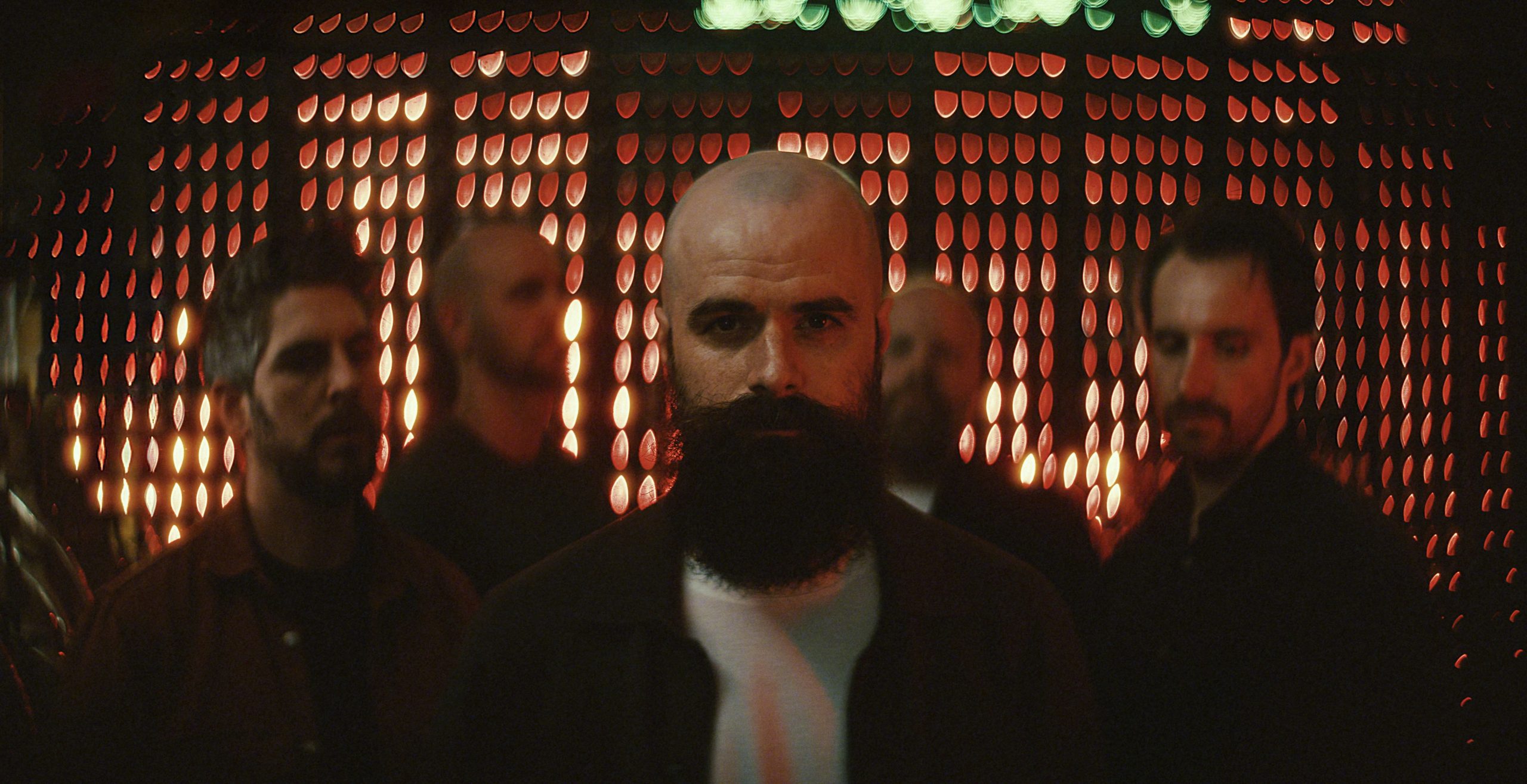


“If I was a carpenter, I’d hope my most recent table was the best one I’d made.” It’s a throwaway line from frontman Andrew Groves, but it’s also the philosophy that has guided his band though almost two decades of evolution. “We wouldn’t be interested in doing it otherwise,” he adds. “Why would anyone else be excited if we aren’t?”
“Excited” is very much what Arcane Roots’ fans are feeling. After eight years of inactivity following 2018’s Landslide, the band have returned to rapturous applause with new single “A Wave, Across the Sea”, while tickets for a handful of comeback performances sold out in a matter of minutes. If the reaction so far is anything to go by, the latest table may be their best one yet.
A Wave, Across the Sea
The new single has been incredibly well received. It feels like a natural step forward for Arcane Roots while still sounding like something brand new. Was that evolution something you consciously set out to achieve?
Andrew Groves: We’re here for progression, and I think our contract with our audience has always been one of progression. We certainly haven’t planned it that way, but it seems as though this return has taken a lot of people by surprise. What has been amazing is discovering that our audience was excited for that and willing to come with us on that journey. I think that can be really hard now, with audience expectations and all the things that come with returning after time away. But it’s been amazing to hear that our audience is really excited for us and understands that we wouldn’t do it otherwise.
Energy Is Never Lost, Just Redirected
Has music always been about exploration for you?
Daryl Atkins: Absolutely. I grew up with a really eclectic mix of influences. My parents listened to a lot of Pink Floyd, and I loved the sense of journey in that music and how immersive it could be. Then, when I was around 13 or 14, I discovered electronic artists like Squarepusher and Aphex Twin, who were pushing the envelope in completely different ways through sound design and unexpected musical choices.
Around the same time, I was learning drums and piano, experimenting with early versions of [recording software] Reason, and trying to recreate those sounds. Looking back, that desire to reach for things that felt just out of reach has always been there, and it still shapes how I think about music today.
Bjarni Biering: My background is very classical. I played piano my whole life and went through a fairly serious conservatory education. At some point, though, I felt like I wanted to go deeper and explore different ideas. That led me into composition, electronics, film, and the relationship between sound and visuals. A lot of my career has really just been about exploring strange ideas and seeing where they lead. It’s never felt like a linear path. It’s more about following whatever feels inspiring and seeing what happens.
AG: I came to music quite late, but once I found it, exploration was definitely the thing that kept me interested. I got into guitar through bands like Blink-182, Green Day, and nu-metal, but then it quickly became a case of, “What’s next?” I wanted to learn harder things and understand how people were doing them. That took me into funk, jazz, Allan Holdsworth, and eventually bands like Reuben and The Mars Volta. The guitar became a way of constantly finding the next challenge, and I think that’s something that’s stayed with me ever since.
"Arcane Roots was founded on the idea of making whatever felt most exciting to us at that moment and letting it become what it needed to be."
Blood & Chemistry
Take us back to the early days. How did Arcane Roots begin?
DA: It really revolved around Reigate College. Me and Andrew were on the music technology course there, and it had this incredible energy. There was a small studio room, a drum room next door, and everyone just wanted to spend all their time in those spaces making music. We came from schools where not many people shared those interests, and suddenly we were surrounded by people who were completely obsessed with production, recording, and songwriting. It forced collaboration as part of the course, but everyone was doing it anyway.
We were playing on each other’s tracks, starting bands, moving between projects, and just figuring out all this gear we’d never had access to before. It was a real frenzy of creativity, and so many people from that environment have gone on to do amazing things.
AG: I think how we properly met was through the function-band scene around that time. We’d both been doing lots of different projects, and there was this shared desire to make things, create things, and improve. Arcane Roots really grew out of that. It wasn’t about chasing a particular sound or trying to fit into something. It was founded on the idea of making whatever felt most exciting to us at that moment and letting it become what it needed to be.
Second Breath
How has the songwriting process evolved with this latest chapter?
AG: It’s been quite different because we’re working across borders now. Bjarni and I met in Iceland around 2019 or 2020, and we very quickly hit it off. We were neighbors, both working remotely because of COVID, and it started with a very simple idea: “Do you want to be in a room with someone and make something?” Then we just kept writing. Bjarni’s writing really speaks to me. I can immediately hear what I want to do with it, but it also takes me somewhere unexpected, and that kept the process exciting.
As we carried on, the ideas started getting bigger and bigger. At some point we looked at each other and thought, “These sound a bit like Arcane Roots.” We both spend a lot of time writing and producing for other people, but these songs felt different. They felt like something we wanted to present ourselves. Once that door opened, things moved very quickly. [Music festival] 2000 Trees approached us about coming back, we realized we already had a song we believed in, and suddenly what started as two people making music together became something much bigger.
"Even playing through the older songs, you can start to feel where this is going. You can hear new possibilities opening up everywhere."
You Keep Me Here
What happened when those ideas were brought to the rest of the group?
AG: It all came together very quickly. We’d been writing this music and thinking, “We’ve got all these ideas and all these songs, and I think they could work through Arcane Roots.” Then it became a case of asking everyone if they wanted to do it. Suddenly we had a festival in the calendar and had to make it happen.
It’s been a huge learning curve for everyone because we’re still quite separated geographically. We only had our first rehearsal recently, but it’s become the highlight of my calendar. It’s so exciting. All of this has been founded on the idea that there’s no ceiling on what we want to achieve, and now, with the five of us, it feels like we can do so much more. Even playing through the older songs, you can start to feel where this is going. You can hear new possibilities opening up everywhere.
Everything (All at Once)
How has the expanded lineup changed the way you’re approaching the music?
BB: With me and Daryl joining (or re-joining), there are suddenly four extra hands, which means we can do a lot more. We’ve got numerous synthesizers, an expanded rhythm section, and a huge range of sounds available to us. The challenge has actually been having too many options. Our first rehearsal was really about focusing on what serves the music best rather than trying to do everything at once. We’re choosing instruments and sounds that support each song in the right way, and that’s been a really exciting process.
DA: It’s opened things up creatively in a way that wasn’t possible before. There are parts that used to be implied on a record that can now be performed properly, and there are new textures and layers that we can bring into older material. The goal isn’t to make things bigger for the sake of it. It’s about finding ways to make the songs feel more complete and making the most of what this lineup can bring.
"I always seem to find my way back to the BOSS OC-2 and GP-10. They've become part of the band's identity."
If Nothing Breaks, Nothing Moves
How are you approaching the live setup for this new chapter?
DA: A lot of it centers around the Roland SPD-SX PRO, which has become the brain of everything we’re doing. What’s been really exciting is that I’m playing melodic parts as well as drums. I’m controlling synthesizers from the kit, using the hi-hat to control filters, and finding ways to perform those sounds live. We’re trying to build a setup where as much as possible is being played rather than left to tracks, and that’s opened up a lot of possibilities for us.
BB: My setup is a bit simpler at the moment. I’m mainly using MainStage with various piano, Rhodes, and synth sounds. What I’m really interested in is having everything at my fingertips and being able to shape sounds in real time rather than relying too heavily on a computer. I’m gradually bringing more pedals and effects into the rig as well, because I love the character they add.
AG: In some ways, my setup hasn’t changed as much as people might think. The BOSS OC-2 became a huge part of my sound very early on, and that octave sound has really been at the heart of Arcane Roots ever since. These days I’m traveling a lot more, so every show is effectively a fly date, and I’ve had to become much more efficient with what I bring. The OC-5 is still a big part of the rig, alongside the GP-10, and even though I’ve experimented with all sorts of alternatives over the years, I always seem to find my way back to those core sounds. They’ve become part of the band’s identity.
Hell and High Water
What excites you most about what’s coming next?
AG: I think, for us, this year is really about introducing people to what this version of the band can do. Coming back through a festival environment has been interesting. There are certain things you can’t do in that setting, but in some ways that’s helped bring the focus back to the five of us and what we can achieve together.
As far as I’m concerned, the line in the sand is that first headline show. I want that to be the best thing we’re capable of creating. That’s really the goal at the moment. Everything we’re doing now is building towards that.
"The headline set is such an intense experience, both physically and creatively, that we wanted the other show to be almost the opposite."
Another thing I am excited about is the second performance at 2000 Trees. The headline set is such an intense experience, both physically and creatively, that we wanted the other show to be almost the opposite. Something more intimate, more relaxed, and an opportunity to play songs that might not fit into the main set.
Beyond that, there are a lot of things we’re not quite ready to talk about yet. We’re still figuring out aspects of the live setup and how all these ideas fit together, and that’s part of what makes it exciting.