

Several years ago, a woman named Marilyn Irizarry was immersed in the long, cold process of securing transitional housing after an extended period of homelessness on Skid Row. Already burdened by severe chronic health issues, the ordeal threatened to derail her, drain her resolve, and potentially lead to relapse. She needed something to sustain her as she forged a new path. She found the Urban Voices Project.
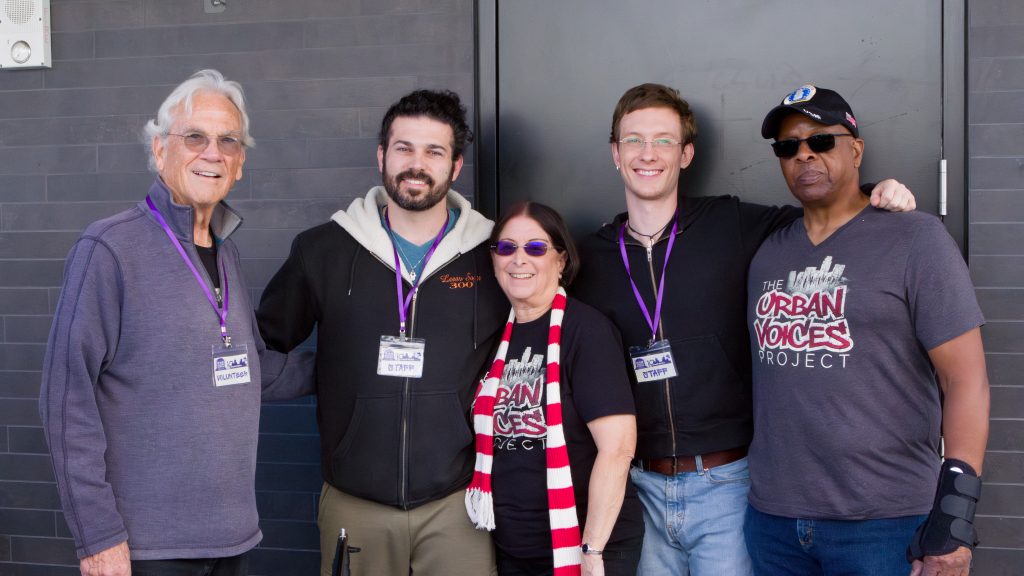
Formed 11 years ago by Colburn School teaching artist Leeav Sofer and outreach coordinator Christopher Mac, the Urban Voices Project is a nonprofit serving singers and creatives from the Skid Row area of Downtown Los Angeles, many of whom are affected by homelessness or are living in transitional housing. Located in what is widely considered the epicenter of homelessness in the United States, Skid Row, the Urban Voices Project has built something akin to a neighborhood music conservatory, offering free tuition and rehearsal time. Its aim is to provide a durable support network through the communal act of singing and music-making. Over the years, the organization has played a key role in helping participants secure both housing and employment.
Hope and Renewal
Irizarry was one such success story. Week by week, she found the strength to return to the organization’s Neighborhood Sings, where participants gather to sing songs of hope and renewal. There, Irizarry rediscovered a sense of purpose. It felt like a spiritual calling, a church without religion. She had found a network of like-minded individuals. “She found that being in community, being part of the music, would carry her through to the next week,” Sofer says. “She’d say that the only thing that got her out of bed was Wednesday at two o’clock.”
These Neighborhood Sings are held at Joshua House in Downtown Los Angeles, a community clinic run by L.A. Christian Health Care, located just south of Skid Row. Inside are an optometrist, a physician, mental health services, and a dentist. The Urban Voices Project understands its work as a service as essential as any of the others housed in the building.
Inside the clinic’s waiting room, there’s that feeling of a familiar limbo governed by cold, indifferent bureaucracy. A woman with a painful toothache goes to the front desk, in desperate need of medical attention. “Have you registered as a patient?” the receptionist asks. “No,” replies the woman in pain. The receptionist tells her to find some paperwork. Off she goes, with more barriers now in her path.
The Urban Voices Project is so vital, in part, because it does not require anyone to go through this needless process. They simply show up and heal. It’s a project that humanizes each of its members, so that they no longer feel discarded by society or like a number in a system.
"She found that being in community, being part of the music, would carry her through to the next week."
Leeav Sofer
Art is Integral
Sofer emphasizes the importance of art as an integral part of the service sector, pointing to a recent program at Stanford University in which doctors are encouraged to prescribe music lessons to patients experiencing depression. “They understand that depression can be mitigated by joining something that provides a sense of purpose,” Sofer says.
Much like the Urban Voices Project, a growing number of physicians are recognizing the tangible medical benefits of music: a powerful, impassioned expression of self and spirit that can help reengage the disenfranchised. “We know from years of research in music therapy that singing releases dopamine,” he adds, “and when people sing together in community, their heart rates begin to synchronize.”
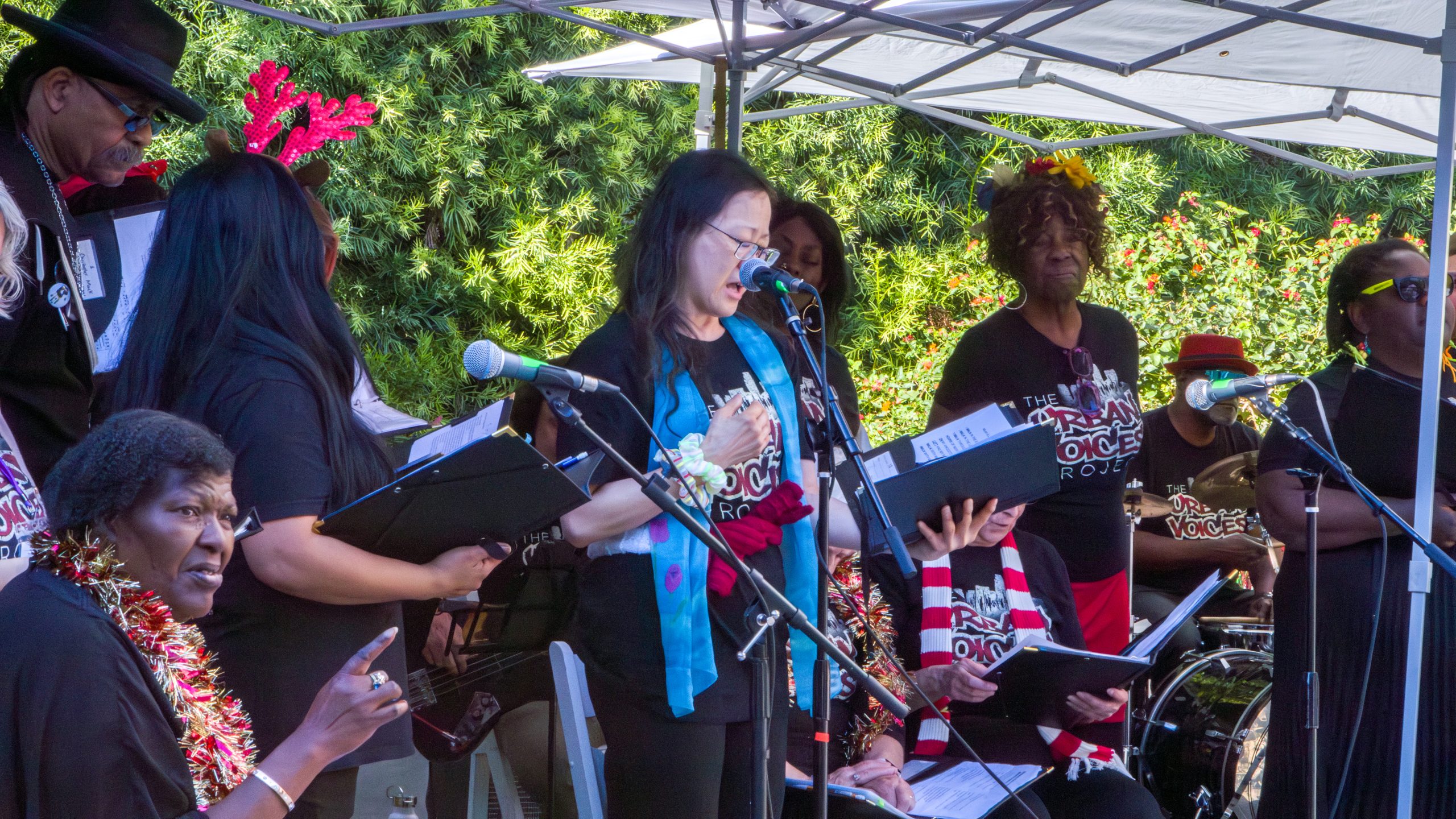
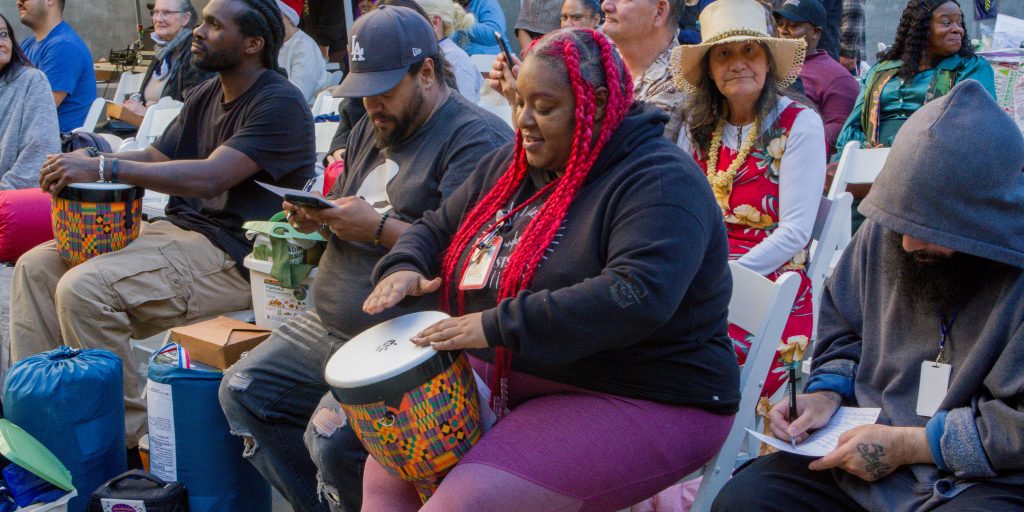
At the Neighborhood Sing, around 15 residents of Skid Row gather, singing in gorgeous harmony, while one man bangs bongos, and another plays electric guitar perfectly in rhythm. They pass around a microphone, one woman takes it, her hands reaching towards the heavens, as she sings with a great, rich timbre. These could easily be professional musicians. Some of them likely are.
“People tend to come to Urban Voices during their hardest moments, and then they graduate when they secure housing and employment.”
Leeav Sofer
A Broader Discussion
There is a broader discussion to be had about the widespread impoverishment produced by the music industry: an industry with few safeguards or support systems for those it leaves behind. Many who have passed through Urban Voices once found success within it. One participant was formerly a backing singer for the Staple Singers; others have been accomplished rappers and producers. The line between being housed and unhoused is perilously thin, and many Americans are far closer to crossing it than they might imagine. “Most people are only a paycheck away from homelessness,” Sofer says.
Homelessness is among the most glaring humanitarian crises of our time, yet unhoused people are still widely perceived as deserving of their circumstances. Many who come to Urban Voices have not struggled with substance addiction, but with chronic illness.
“Most people are able to dehumanize these people because they dehumanize their story,” Sofer says, who then begins pointing at a tree outside. “As humans, we compartmentalize. We don’t see all the individual leaves, just the tree itself.” For Urban Voices, music is a way to undo that abstraction, to restore specificity and humanity. It is the most direct point of connection.
That philosophy shapes how the organization operates. “Charity is inherently a power dynamic,” Sofer explains. “Society tells you that you’re supposed to have clothes on your back, shoes on your feet, a job, a house, your health. If you’re missing one of those things, you’re broken and need to be fixed. A charity says, ‘I can give you what you need so you won’t be broken anymore.’” Urban Voices rejects that premise. There is nothing transactional or hierarchical about music.
"Music becomes a vehicle for telling life stories and articulating struggle, often resolving—if not in certainty—then in hope. "
A Vehicle for Sharing
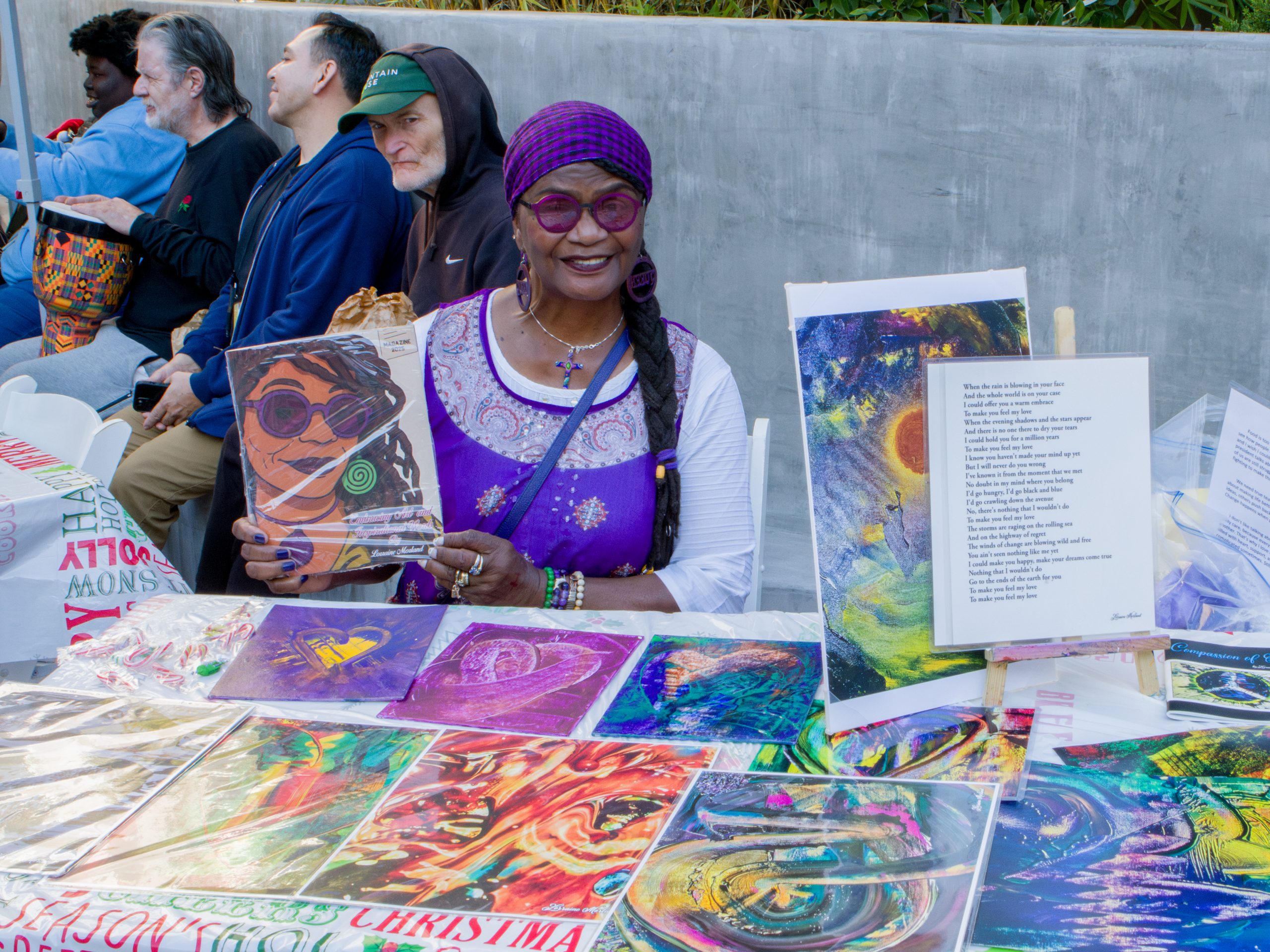
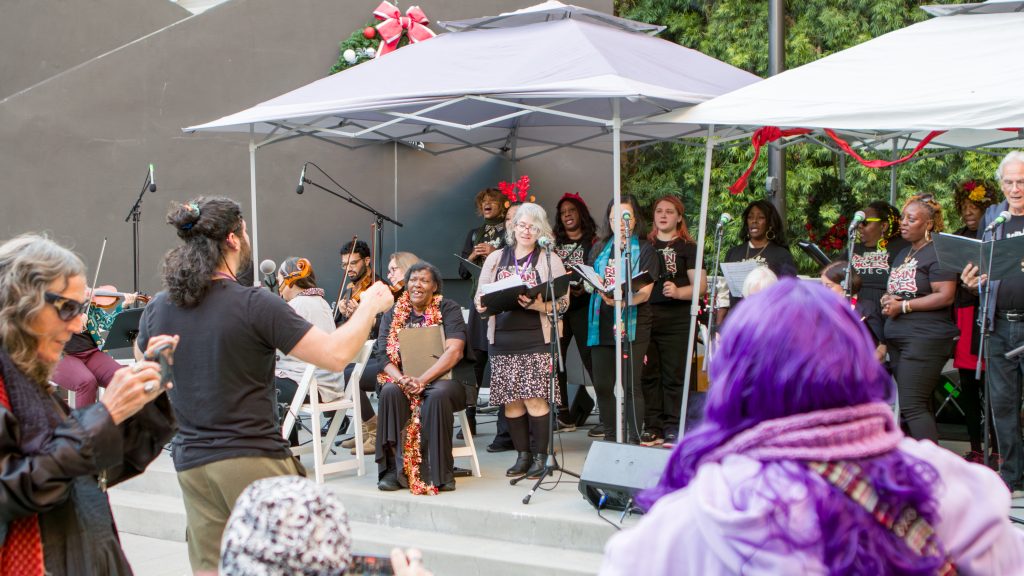
That balance is on display at the organization’s holiday showcase. Before the choir’s closing performance, members of the Urban Voices Project take part in an open mic, sharing original compositions. Across the songs, one word recurs again and again: hope. Music becomes a vehicle for telling life stories and articulating struggle, often resolving—if not in certainty—then in hope.
The choir then takes the stage, twenty voices strong. They perform Jon Batiste’s “Freedom,” followed by Handel’s “Hallelujah,” which Sofer urges the audience to sing along with. For the duration of the piece, residents of Skid Row and Beverly Hills join together, finally singing the same tune.
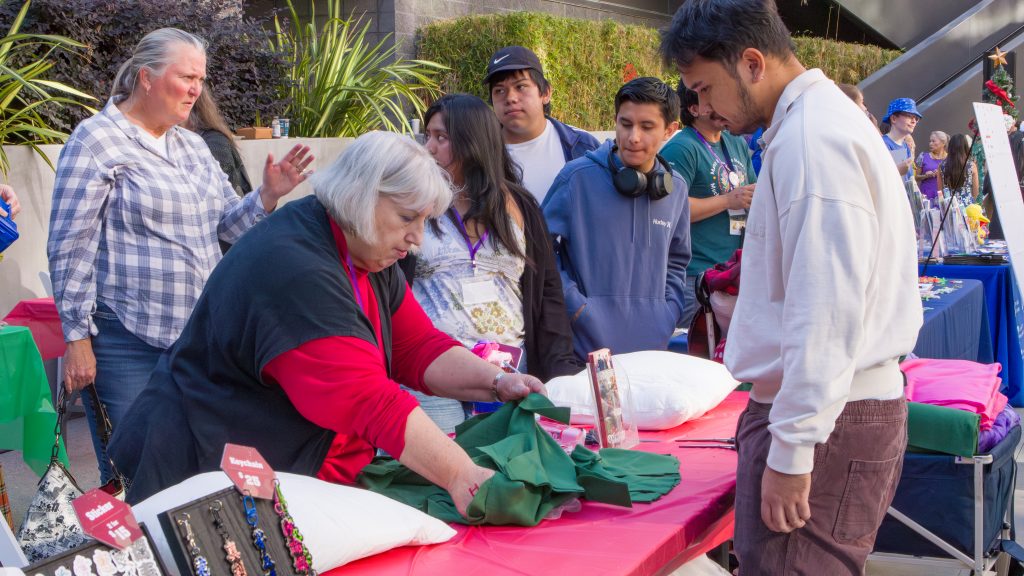
At the back sits Irizarry, teaching people to make sock puppets, a passion she has since developed. She no longer sings with Urban Voices. “People tend to come to Urban Voices during their hardest moments,” Sofer explains, “and then they graduate when they secure housing and employment.” Largely thanks to the Urban Voices Project, Irizarry now has both. She recently served on the organization’s board of directors and continues to champion their work.
Housed or unhoused, Urban Voices has always seen her the same way. “Art doesn’t see you as broken,” Sofer says. “It sees you as a whole, full person from the moment it meets you.”