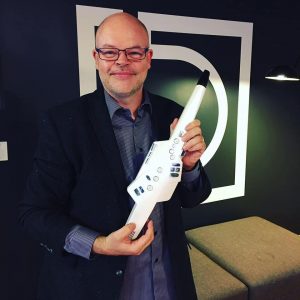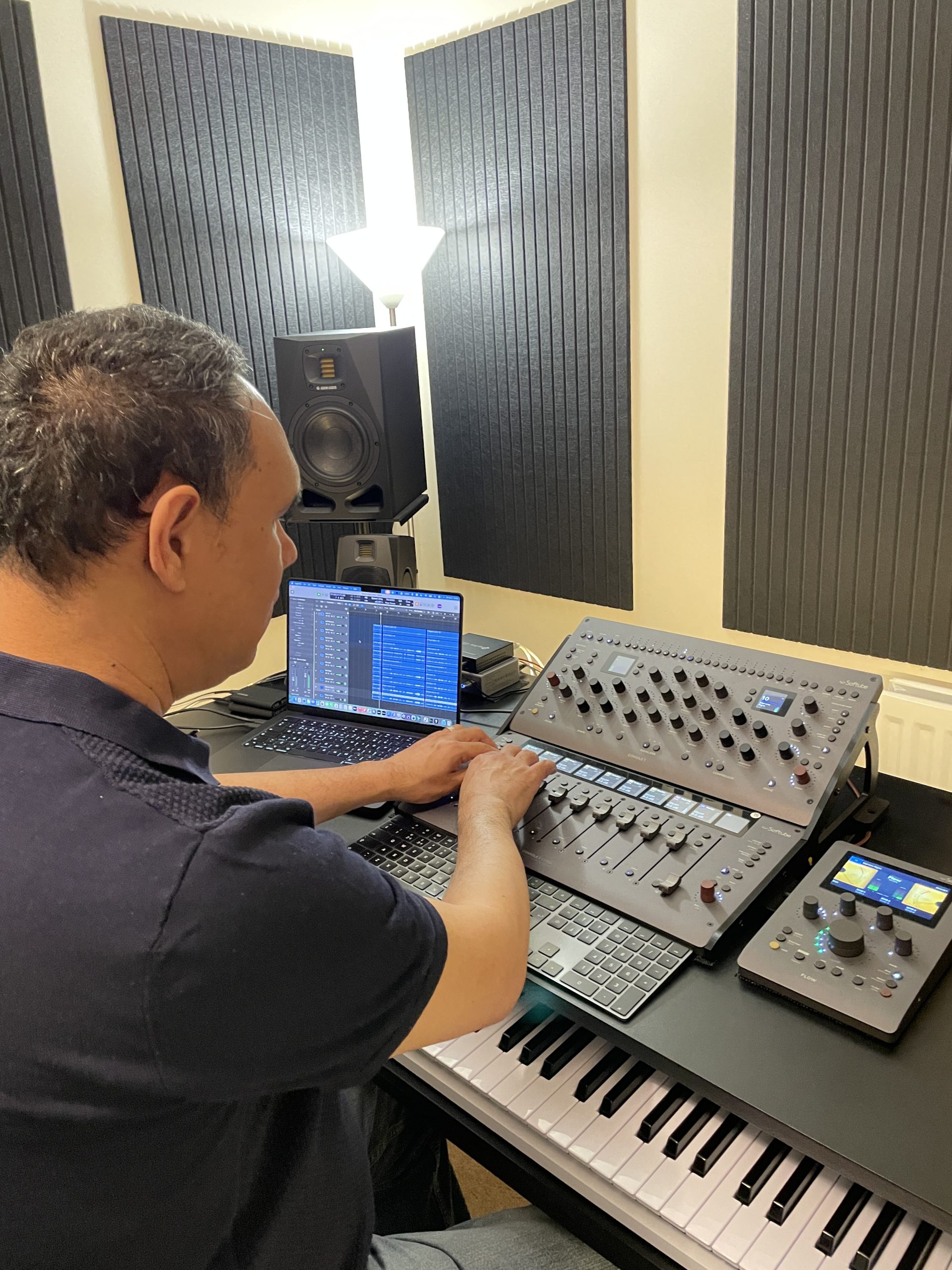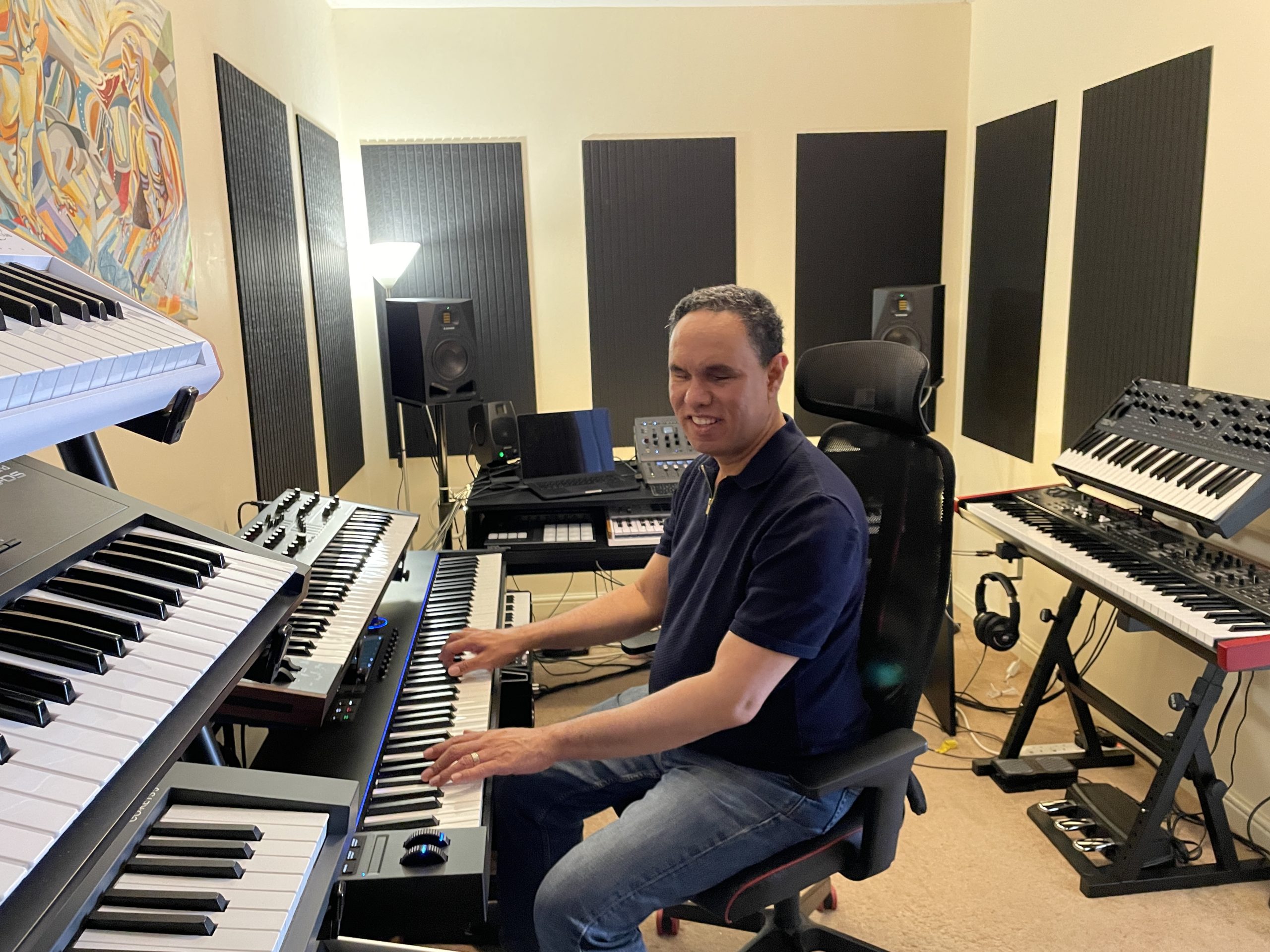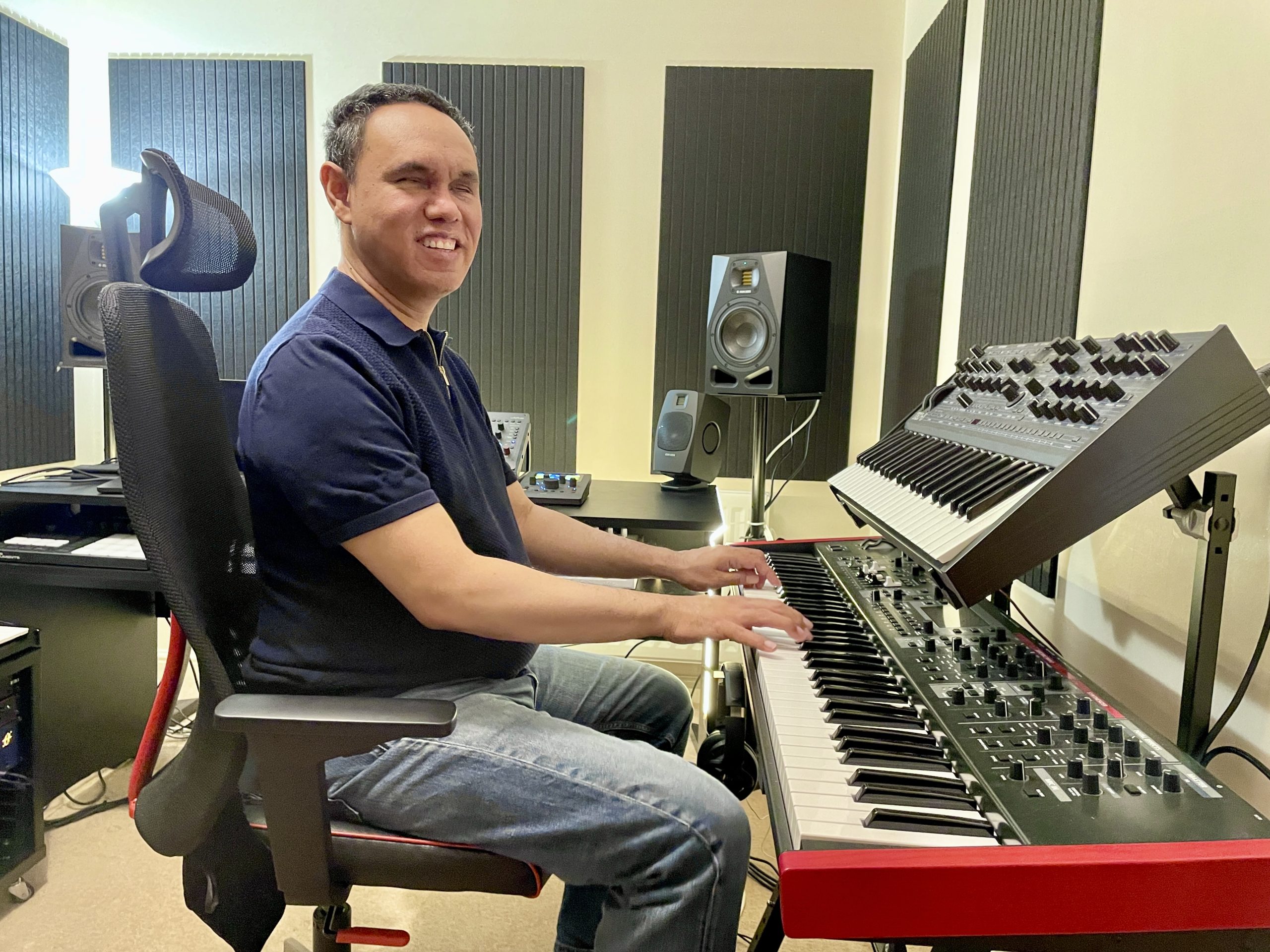


Jason Dasent has been blind since birth, a musician since childhood, and an accessibility advocate since the moment he realized the instruments he loved weren’t designed for people like him. Based in the UK and originally from Trinidad, he has collaborated with music tech companies to make their tools genuinely usable by blind and visually impaired musicians.
His latest collaboration brings that same spirit to Roland. Over the past six months, Jason has developed a V-STAGE Accessibility Guide, the first dedicated written and audio support resources for visually impaired musicians using the Roland V-STAGE Performance Keyboards. These materials replace the diagram-heavy conventions of standard owner’s manuals with something blind musicians can actually use. I sat down with Jason to talk about his musical origins, his journey into accessibility work, what drew him to V-STAGE, and what truly inclusive music technology might look like in the years ahead.
Emotions Resonate
Tell us how your musical life started.
I think my musical life actually started before I realized it started. I remember being, like, three years old, four years old, sitting in a rocking chair at home and hearing music, and something about it just felt special, you know? I remember listening to things like harmony clusters, listening to the Carpenters, and something just seemed to resonate. When music was playing, I was good. I felt happy, sometimes melancholy, sometimes even a little scared. At three, four, five years old. Different music just conjured up so many different emotions—not knowing, at that time, that one day I’d be playing.
Fast forward to maybe nine or ten, a friend had a little toy keyboard, and I picked it up, played a few notes, and realized: it doesn’t sound like noise. It sounds like music. And that happened to be around Christmas time, so guess what my Christmas present was that year? My first keyboard. From there, one thing just led to another. By twelve, I realized I had a kind of God-given gift: I could pretty much play anything I heard on the radio. By fifteen, sixteen, I was in recording studios, doing jingles, doing production for artists. I remember being in the studio till five in the morning, going home, taking a shower, and going to school.
Roland Roots
You were in the Roland family from a very early age.
From a very early age, yeah. A Roland Alpha JUNO-1 (synthesizer) and a TR-505 (drum machine). And at that time, there was no such thing as accessibility, so my brother would sit with me for hours, and we’d learn every single button on the drum machine. We’d buy every keyboard magazine and look forward to the end of the month to get a new one. My brother isn’t into music, but he’s into technology, and he was interested enough to share my passion.
And my mom, I remember my mom reading the entire Roland D-20 manual onto cassette tape for me. Pages and pages. And when there were diagrams, she’d get special paper; there was a kind of paper where, if you trace on it, it embosses, so you can feel what’s been drawn. She would trace out the diagrams so I could feel them with my fingers. They did whatever it took so that I didn’t miss out.
"He was my eyes before there was accessibility. He was the accessibility."
The Mind’s Eye
For those reading this who are learning about you for the first time, you’ve been blind since birth?
I have been, yeah. I did two corneal transplants when I was young, and I saw a bit for a while, but I rejected them because the technology was in its infancy; they didn’t have the proper matching and everything. But I did see for a short period of time, and I remember seeing colors. So I have a small window of reference to them. After that, my experience of color comes from memory and from music.
How does blindness shape the way you hear and experience music? And I want to be clear, not thinking about it as a limitation, but as a different perspective on sound.
Okay, so, and this may be an opinion, but I think it’s an accurate one. People say that blind people hear better. There’s a kind of Stevie Wonder syndrome, right? Everybody knows the genius that Stevie is. So it leads to this thinking that all blind people are into music, all blind people are cut out for music. That’s kind of not really true. I teach a lot of students, and I get some people who are brilliant musicians who happen to be blind. But I also get some people where, because they’re blind, their parents think they have to do music. Music may not be for them, right?
"I'm not hearing better, but I focus in depth. And the music represents the things I don't see."
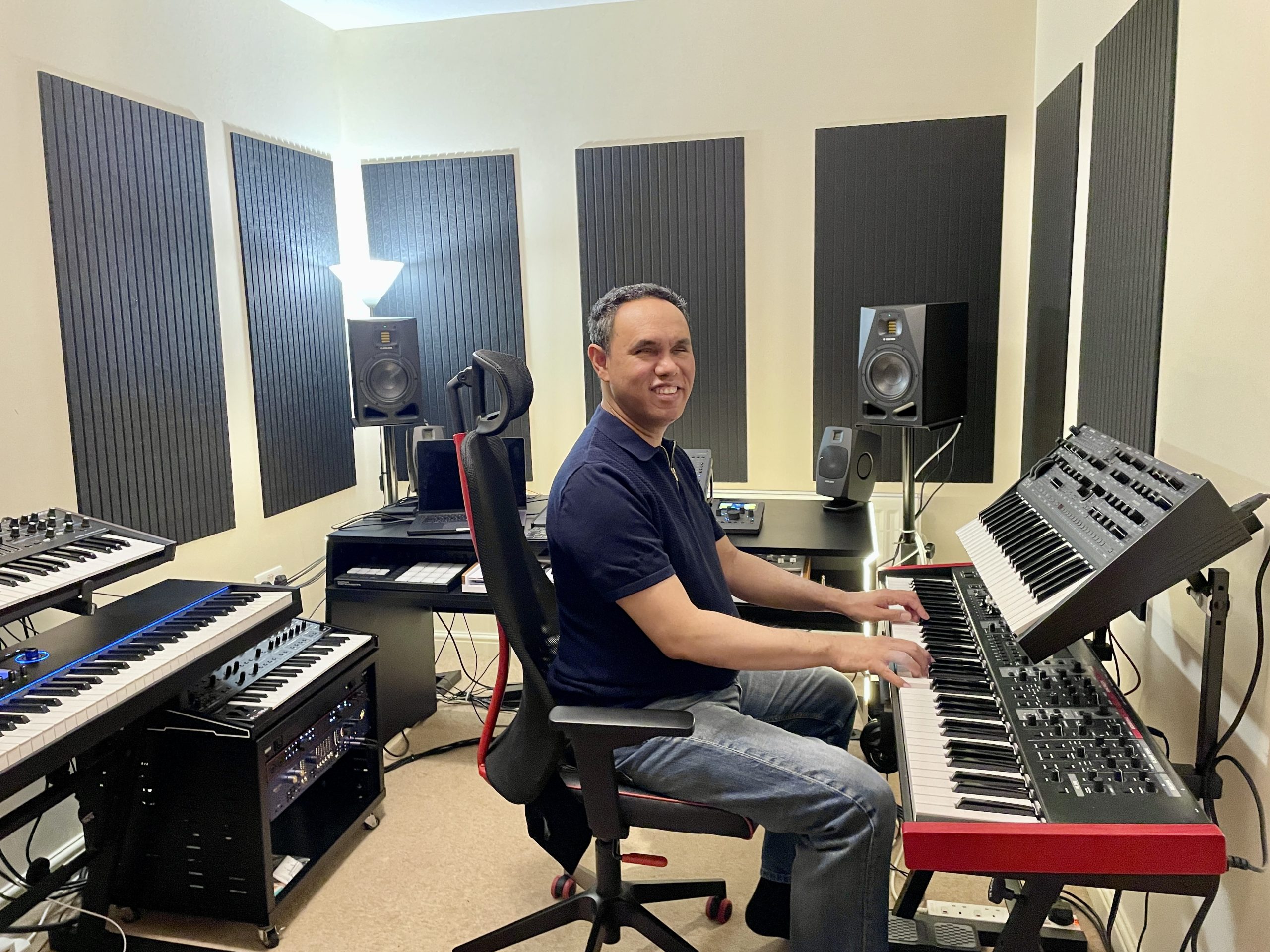
As for hearing better, I don’t think it’s true. My wife, Sarah, hears better than I do, honestly. Sometimes I’m right at the end of a mix, and Sarah walks in and says, “That voice has too much reverb,” or “The compressor is squeezing it too hard.” What I think is unique is that we focus differently. When I’m in the studio, I form a kind of 3D image of the music: wide, narrow, deep. I picture things. And the music represents the things I don’t see. So I might pull up a JD-800 Crystal Rhodes patch, and I’m thinking green and dark blue. Serene. Then a bass is red, fire. And the Caribbean percussion from the SRX library? That takes me straight back to Trinidad, to Carnival. So I guess it brings out my mind’s eye, you know.
The Immediacy of V-STAGE
And then, about a year ago, you reached out to me about Roland V-STAGE. What grabbed your attention?
First of all, it was Ming. He called me at something like six in the morning. “Jay, did you see Roland’s new keyboard?” He sent me the YouTube link right then.
The first thing was the sound. Hearing the electric piano with the chorus — oh my God. That was my first reaction. But then I started reading about it, and what jumped out was all the physical buttons. Everything was going touchscreen, touchscreen, touchscreen, and then this thing shows up with physical controls, you know? I kept reading, and Ming would describe the unit to me. “Jay, they have the octave buttons right there, the split buttons right there.” And I was thinking: I could form a picture of this. I can actually build a mind’s eye layout of this keyboard just from the description.
V-STAGE ORGAN SECTION
V-STAGE ACOUSTIC PIANO SECTION
And what I love about V-STAGE is the immediacy of it. Sometimes I’m not in sound design mode, but I want to go on stage, pull up an electric piano, layer it with some strings, and just play. With a touchscreen, you might have your splits set up, but your hand could gently brush the screen mid-song and suddenly: brass patch, something wrong, a thousand people in the audience watching. That insecurity is real. With V-STAGE, that’s not going to happen for me. Everything is right there. It’s in my mind’s eye. I know where I am. And that just made it right on all levels.
"Sometimes I'm not in sound design mode, but I want to go on stage, pull up an electric piano, layer it with some strings, and just play."
Every Connection
You told me what was really missing: support documentation designed specifically for visually impaired players.
Right. And I want to say, the Roland team was incredible. They recorded Zoom sessions for me, walked me through the instrument in detail, were always one email or call away. Sarah sent me hundreds of WhatsApp messages describing what came up on screen as we navigated menus together. For that month when Roland sent V-STAGE over, if you picked up my phone, you’d find millions of messages: okay, press menu, then right arrow eight times to get to the sustain pedal setting, you’re sure, yes, okay, you’re there.
But I kept thinking about the musician who doesn’t have that network. Who doesn’t have a Sarah. Or a Ming. Or a brother like mine. I figured: I’ve been building this knowledge for years. I can take what’s in my mind’s eye, get it out, and make it available in written and audio form. So that even if you’re sitting there alone, you have that support.
Walk us through what you’ve actually created.
The core challenge is that owner’s manuals, as good as they are, are fundamentally built around diagrams. And diagrams have almost no value to a blind person. My mom did her best. She’d emboss those diagrams onto special paper. But she wasn’t a musician, and a set of traced lines on a page doesn’t tell you what you’re touching or why it matters. You kind of understand that something is there, but you don’t understand what these touching these lines mean.
So, what I did was replace the diagram with spatial, verbal description. Instead of showing you a picture of the rear panel, I describe it as a journey from left to right. The first port you’re going to come to, if you touch the back of the keyboard and move from left to right, is Main Output Left, XLR. The second one, moving right from there, is Main Output Right, XLR. Then, if you move your hand a little further, you’re going to feel the quarter-inch outputs: main left, then main right. I describe every control, every button, every connection, in the order your hands will actually find them. In words. And if I’m telling you that, you’re going to understand it, right?
Sarah helped me refine all of this. Those WhatsApp messages were basically the first draft. We scripted it, shaped it, and produced it both as written text, which works with screen readers, and as audio files that someone can listen to while their hands are on the keyboard.
"For that moment—for that session—I'm not blind."
Changing Perception
You also created YouTube videos, which surprised me when you suggested it. That seems counterintuitive. A video for a blind audience?
I know I sound crazy. But I’m always thinking crazy, Paul, you should know that after knowing me for six years! (laughs) Okay, two reasons:
First, you don’t only have blind users. You have low-vision customers, too. Someone who uses a screen magnifier, or takes a hybrid approach, sometimes using voiceover, sometimes just looking closely at the screen. I have a student in Canada who does exactly that. She might genuinely benefit from a video with a good verbal description alongside it. So you’re catering for those people too.
Second reason, and I think this is actually the bigger one, the videos are for the sighted user. One of my goals is that in five years, I don’t want to be having the accessibility conversation as a separate thing anymore. I want it to just be the norm. Think about Siri. A few years ago, that would have been called an accessibility feature. Now everybody uses it. My kids and my wife use audio description on Netflix even when I’m not in the room. So I thought, by creating videos, I can give the sighted musician a view of how a blind person perceives and navigates an instrument. Paul, put down that diagram for a minute. Just listen to this. Let me see if your perception changes.
I also lecture at the Royal Birmingham Conservatoire. And now, when I’m with a sighted student, I can pull up a V-STAGE video, and we’re looking at and listening to the same thing at the same time. We’re talking the same language. That integration, and that’s what I’m after.
The Color and Texture of Music
The scale of this matters. Over two billion people on this planet have some form of visual impairment. Roughly 40 to 50 million are completely blind, another 250 million with moderate to severe impairment: a population the size of the United States.
Yeah. And those people love music. They want to make music. They have the creativity, the drive, the talent. What they often don’t have is the right on-ramp. So if we give them that opportunity, these materials and these resources, you know what’s going to happen. They’re going to pull out their credit card. Not just for Roland’s benefit, for their own. They’ll be able to find employment through music. Realize their musical dreams. See music the way I see it: as color, as texture, as a world they can inhabit fully.
"I want accessibility to just be the norm. Not a separate conversation—just the way things are built."
I want to end with something you’ve said to me that I’ve never been able to forget. When you sit behind an instrument that’s been designed with accessibility in mind, what happens?
Yeah, I remember exactly what I said. For that moment, for that session, I’m not blind. Because the technology is just right. It’s just there. My cognitive load is lessened greatly. I can do what I came to the session to do: play and create music. I don’t have to worry, I don’t have to remember menus, I’m just operating as a sighted person, and a sighted person could be sitting right next to me, and we’re talking the same language. I’m not blind for that hour. Or three hours. However long I’m sitting with the instrument.
And that’s what I get from the Roland V-STAGE right now. That’s what it gives me. And I just imagine taking it further, so that when any blind musician sits behind an instrument designed with them in mind, it’s like when you put on your glasses, Paul. You can suddenly see better. It’s the same thing. The experience is magical. It’s free, it’s liberating, it’s exciting, and it’s something I want to share with every visually impaired musician who’s out there wondering if this world is for them.
It is. It absolutely is.
Access V-STAGE Accessibility Resources
- Written guides, audio walkthroughs, and video resources created by Jason Dasent are available here.
- Learn more about Jason Dasent
- Learn more about Roland V-STAGE