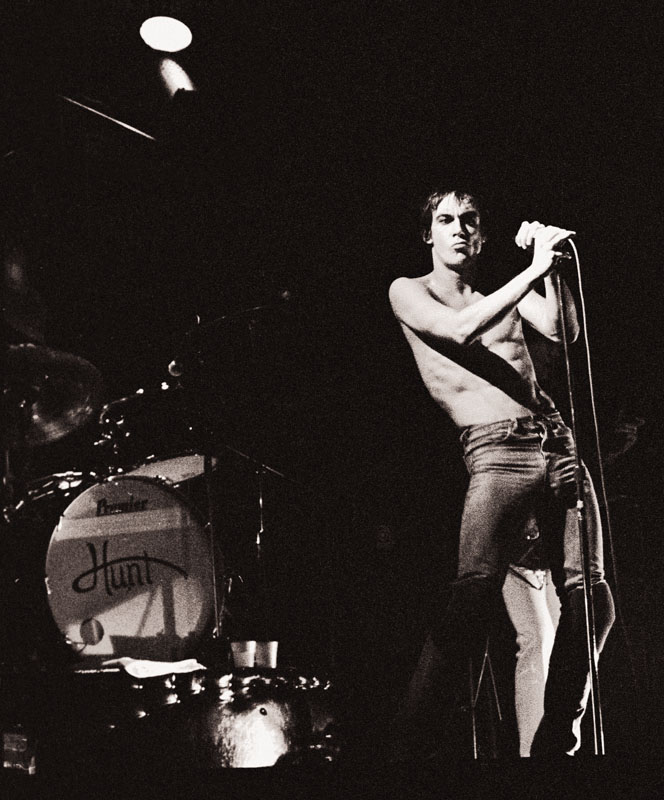


It’s a rare song that can evoke a specific location within moments of kicking in. The woodsy throb of the Roland drum machine that drives Iggy Pop’s classic “Nightclubbing” does precisely that with the city of Berlin. While recording sessions for its parent album, The Idiot, also took place in Munich and France, “Nightclubbing” will never shake the specter of David Bowie’s time in the German capital. That lore comingles with the instrumentation to conjure a hazy cityscape, an auditory thumbprint. At its center, a slapback-saturated swing takes the listener on a nighttime stroll where nothing and anything could happen.
Escape to Europe
The ’70s had already been a turbulent, transformative decade for both Pop and Bowie when the pair decided to decamp to Europe. The plan was to outrun the substance abuse issues plaguing both artists. In characteristic Bowie fashion, the exercise in expatriatism led to an inspired period of creative activity crowned by his heralded Berlin trilogy: Low, Heroes, and Lodger. No less influential is the debut solo record Bowie produced for Pop: The Idiot.
The album, which shares its title with a Fyodor Dostoevsky novel, buzzes like a dim yellow lightbulb in a dilapidated warehouse. Mirroring his relationship with Lou Reed, Bowie was a longtime patron of Pop—first resuscitating the Stooges, then mixing the band’s final opus, Raw Power. Despite their intertwined pre-history, the oppressive mechanical mood of The Idiot represented a major shift from Pop’s rock formalism and hinted at Bowie’s future esoteric undertakings.
Method of Madness
Unlike the frantic off-the-floor recording method of garage acts like the Stooges, The Idiot bloomed out of loose, experimental sessions. Bowie composed the bulk of the music, hopping between a variety of instruments and layering sounds over which Pop added his droll societal observations.
The resulting tunes were darkly humorous and oddly funky, like a junkshop of toys clattering at once, creating a friendly din. “Funtime,” with its barked imperative refrain, is a declaration of purpose, yet its sarcastic tone is at odds with its title. Another highlight, “China Girl,” offers the album’s sole hint of sentimentality, and would greatly improve Pop’s fortunes when Bowie covered it on 1983 commercial juggernaut, Let’s Dance.
"Meeting at the intersection of Brecht and Kraftwerk, 'Nightclubbing' is certainly an 'ice machine,' as Pop sings in the opening verse."
Yet no single moment encapsulates the album’s disoriented mood as well as “Nightclubbing.” Pop revealed the song is meant to evoke the “incredible coldness and deathly feeling” of the nocturnal reveries in which he and Bowie indulged. Meeting at the intersection of Brecht and Kraftwerk, “Nightclubbing” resembles the “ice machine,” Pop sings of in the opening verse. For another classic Pop moment, check out the vacant way he tosses off, “Oh, isn’t it wild?” The line sounds like he couldn’t be bothered to get out of bed for anything short of the Taj Mahal, and even that would be a bore.
A Murky History
Then there’s the sauntering drum machine beat. After writing the skeleton of the song with piano and a Roland drum machine, Bowie was ready to lay live drums. Satisfied with the lean accompaniment, Pop declared the robotic result “better than a drummer,” and reportedly cranked out his lyrics in ten minutes flat.
Time is a funny thing, and the murky history around The Idiot makes it difficult to determine the precise model of the drum machine on “Nightclubbing.” However, this is certain: Shuffle-A from the Roland CR-78 sounds remarkably like the recording, though there are reports that Bowie owned a TR-77 and used it on Low.
"Satisfied with the lean accompaniment, Pop declared the robotic result 'better than a drummer,' and reportedly cranked out his lyrics in ten minutes flat."
One aspect of “Nightclubbing” not in question is its lasting influence. Grace Jones, The Human League, and Siouxsie Sioux’s project The Creatures all covered the song. Nine Inch Nails famously interpolated the Roland kick drum into their own bacchanalian ode, 1994’s “Closer,” which also featured the Roland TR-606.
If you feel like recreating the unmistakable groove on your own, the vintage sound is easy to achieve using the Roland Cloud CR-78 Software Rhythm Composer. To emulate the drippy, delayed effect of the “Nightclubbing” beat, try adding the RE-201 Space Echo or another analog-style delay. You’ll be swaggering down the midnight streets of Berlin in no time, like the vampiric Bowie and Pop of legend.